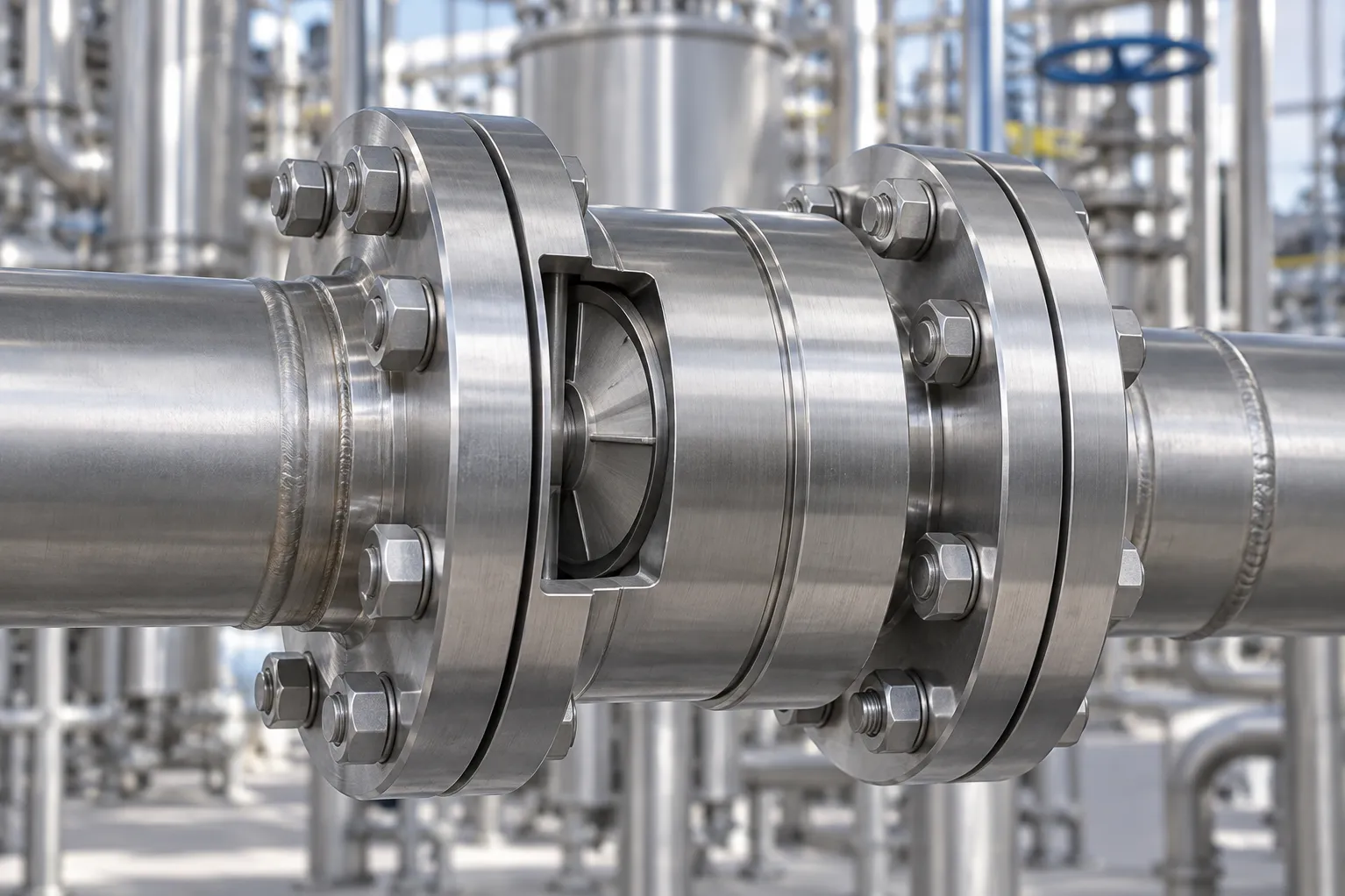
The rupture disc receives most of the attention in a pressure-protection system, but its holder is equally important. The holder positions the disc, provides the correct support and helps establish a reliable seal between the process and discharge sides.
A rupture disc holder supplier should therefore be evaluated on dimensional accuracy, material compatibility, installation control and compatibility with the specified disc. Buying a holder based only on nominal size can lead to leakage, damage or uncertain activation behaviour.
Treat the Disc and Holder as a Matched Device
Rupture discs are tested and specified for use with defined holder arrangements. Differences in seating diameter, surface geometry, support features or flow direction can affect the way a disc is clamped and opened.
ISO documentation describes a rupture-disc device as including the rupture disc and its holder. This definition highlights why the assembly should be assessed as one pressure-protection device.
Before purchasing a replacement, identify:
- Disc manufacturer and model
- Holder model
- Nominal size
- Pressure class
- Flange standard
- Material
- Flow direction
- Existing tag details
- Connection dimensions
If identification is incomplete, do not assume that a visually similar holder is compatible.
Check Pre-Torque and Insert Options
Insert-type holders are fitted between companion flanges. Some assemblies may use pre-torque arrangements that retain specified clamping on the disc before the holder is installed in the piping system.
The preferred configuration depends on the application and manufacturer’s design. Procurement teams should ask how the holder is assembled, whether special tools are required and how correct installation can be verified.
Where frequent disc replacement is expected, ease of maintenance should be considered without compromising installation control.
Match Materials to the Environment
The holder may contact process fluid, relieved material or external atmospheric contaminants. The selected material should suit corrosion, temperature and mechanical requirements.
Review both process-facing and discharge-side exposure. A downstream relief header may contain moisture or corrosive vapour even when the normal process side appears compatible.
Material selection should also cover studs, identification tags, gaskets and sensor interfaces where applicable.
Verify Flange and Piping Compatibility
Nominal size does not fully define the piping interface. The supplier needs the flange standard, pressure class, facing and available installation dimensions.
Misaligned piping can impose loads on the assembly. Poor flange condition, unsuitable gaskets and uneven bolt tightening can also reduce sealing reliability. The holder should not be expected to correct defects in the surrounding piping.
Reduce Common Installation Errors
A well-designed holder can include features that discourage incorrect assembly, but site procedures remain essential. Common mistakes include:
- Installing the disc backwards
- Reusing a damaged disc
- Mixing disc and holder models
- Fitting an extra gasket in the wrong location
- Applying uneven bolt torque
- Damaging sealing surfaces
- Leaving shipping protection in place
- Obstructing the discharge path
Clear direction arrows, durable identification and accessible installation instructions help maintenance teams avoid these errors.
Compare Lifecycle Support
When evaluating a rupture disc holder supplier, consider the availability of replacement discs, dimensional records and technical support. Standardising selected assemblies across similar equipment may reduce inventory complexity, provided the process requirements genuinely match.
For older plants in Vadodara and Gujarat, maintenance teams may encounter holders with unreadable tags or discontinued models. Flammer Technologies Private Limited can review available details and discuss suitable supply options, but critical dimensions and process data should be independently verified before replacement.
A rupture disc holder is not merely a mounting ring. It is a functional part of the pressure-relief device. Careful compatibility checks, correct materials and disciplined installation help the disc perform as intended when the protected system experiences an overpressure event.
Keywords