A pressure safety valve protects a vessel or process line only when its set pressure, capacity, inlet piping and discharge route match a credible overpressure event. By the end, you will be able to distinguish the right relief device, define the engineering data needed for sizing, and check whether an installed system will actually protect people and equipment.
Key takeaways
- Set pressure from MAWP, not normal operating pressure.
- Match the relief device to gas, liquid, vessel and overpressure scenario.
- Size for credible cases such as blocked outlet, fire or control-valve failure.
- Verify discharge routing, isolation valves, certification and maintenance access before purchase.
What happens when process pressure exceeds the safe limit?
A process equipment safety valve opens when pressure reaches its set pressure, preventing the protected vessel or line from exceeding its permitted pressure. The set pressure is chosen from the equipment’s maximum allowable working pressure (MAWP), not from normal operating pressure; the applicable code determines permitted accumulation above the set point.
1. As pressure rises, the spring or pilot mechanism holds the valve closed. Operating pressure must remain below the set pressure, or repeated simmering can damage the seat and cause leakage.
2. At set pressure, inlet force overcomes the closing force. The disc lifts from its seat, and a spring-loaded valve may snap toward a higher lift to pass the required relieving flow.
3. The valve discharges vapour, gas, liquid, or a mixed phase into a designed outlet system. Its capacity must match a credible scenario such as blocked outlet, fire exposure, control-valve failure, tube rupture, reaction, or thermal expansion of blocked-in liquid.
4. As pressure falls, the closing force becomes dominant. The disc returns to its seat at the blowdown pressure, which is below the set pressure, and the valve must seal without dangerous chatter or continuing leakage.
Correct industrial pressure protection also requires an open flow path. A locked- or car-sealed-open isolation valve, verified line-up, suitable discharge routing, and tested valve prevent a correctly sized process equipment safety valve from being defeated in service.
Which relief device fits a vessel, pipeline, tank or blocked-in liquid?
Choose by the overpressure scenario, fluid phase and required response—not by the vessel nozzle size.
| Option | What it means | When it applies |
|---|---|---|
| Pressure safety valve | A spring-loaded or pilot-operated device that opens rapidly at a set pressure and reseats after pressure falls | Gas or vapour service on process vessels, boilers and equipment facing blocked outlets, control-valve failure, fire or reaction overpressure |
| Pressure relief valve | A broader term for an automatic valve that releases excess pressure; in some standards, it includes pressure safety valves | Liquid, gas or vapour systems where controlled discharge and reseating are required |
| Pressure-vacuum relief valve | A tank venting device that opens for both excess internal pressure and vacuum | Atmospheric or low-pressure storage tanks during filling, emptying, thermal breathing or vapour-space changes |
| Thermal relief valve | A small-capacity relief valve for liquid expansion in an isolated section | Blocked-in liquid pipelines, exchanger sections or pump discharge segments exposed to heating; it is not a substitute for full vessel relief |
| Rupture disc | A non-reclosing membrane that bursts at a specified pressure and temperature | Rapid, fail-safe protection for vessels or lines where leakage-free isolation, corrosive service or very fast pressure rise matters |
“Pressure safety valve” and “pressure relief valve” overlap in everyday plant language, so confirm the governing code and fluid phase. Pressure relief valve benefits include automatic repeat protection, but a ruptured disc requires replacement after activation.
Never use a small thermal valve for fire or reaction relief. That mismatch leaves the vessel under-protected.
How do you set pressure and size the valve for a real overpressure case?
Set pressure is chosen from the protected equipment’s MAWP, not from its normal operating pressure. Keep it above the highest stable operating pressure so routine fluctuations do not cause lifting, but set it at or below MAWP for a single-valve installation.
The applicable code determines how much pressure may rise above set pressure during discharge; this is the allowable accumulation.
Use this sequence:
1. Confirm the vessel or piping MAWP from the nameplate, design drawing and construction code. Identify the weakest protected component, including flanges, jackets and connected equipment.
2. Define the credible relieving case: blocked outlet, fire exposure, control-valve failure, utility failure, runaway reaction, tube rupture or liquid thermal expansion. Do not size a thermal-relief valve for a vapour-release scenario, or use normal flow as the relief load.
3. Apply the governing code, such as ASME Section VIII, Division 1 for a vessel or ASME B31.3 for process piping, together with the project specification. Use its permitted accumulation and required set-pressure rules.
4. Run API 520 sizing with the relieving pressure, temperature, fluid phase, molecular weight or liquid properties, compressibility, required mass flow, discharge coefficient and built-up or superimposed backpressure. Select the certified orifice area that passes the governing case.
Record MAWP, operating pressure, set pressure, accumulation, relieving case, capacity, backpressure, materials and discharge destination in the purchase specification. That record is the basis for industrial pressure protection and makes quotations technically comparable. Recheck the calculation when process conditions or connected piping change.
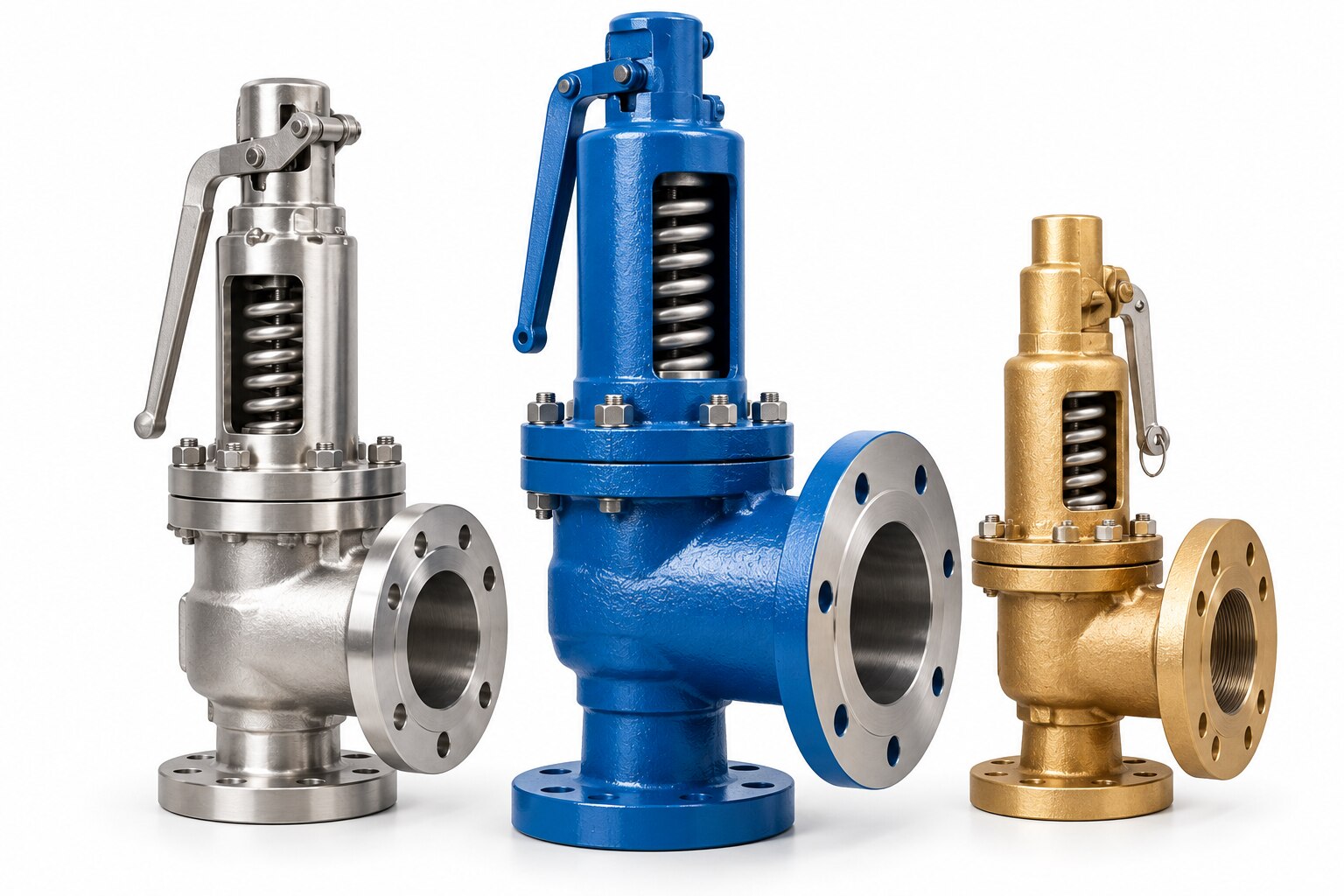
When are spring-loaded, balanced-bellows and pilot-operated valves suitable?
Backpressure decides whether a conventional spring-loaded valve will open and reseat predictably. Choose it when outlet pressure is low and stable relative to set pressure; fluctuating or high backpressure can reduce lift, alter set pressure and cause unstable opening or chatter.
| Arrangement | Suitable when | Main limitation |
|---|---|---|
| Spring-loaded | Clean gas, steam or liquid service with low, stable backpressure | Direct spring loading loses performance as backpressure rises |
| Balanced-bellows | Variable or substantial backpressure, especially where discharge-system pressure changes | Bellows must withstand the relieving temperature and remain chemically compatible |
| Pilot-operated | High-capacity gas or vapor service, tight shutoff and stable control are important | A blocked sensing line, dirty pilot, frozen impulse line or inadequate pressure differential can prevent correct operation |
Fluid phase determines capacity calculations: gas and vapor sizing uses relieving pressure, temperature, molecular weight and compressibility, while liquid sizing uses density, viscosity and flashing risk. Use relieving temperature, not normal operating temperature, because heat can weaken springs, bellows, seals and seat materials.
Clean, dry service suits pilot-operated designs. Solids, polymerising fluids, corrosion products or viscous liquids can foul a pilot or sensing passage; a spring-loaded or balanced-bellows arrangement may be more dependable after checking materials and capacity.
For a pressure safety valve in Vadodara, specify these conditions alongside MAWP, backpressure and discharge destination so local suppliers compare equivalent designs.
What installation and purchasing checks make protection work in Vadodara plants?
A valve can be correctly sized and still fail if an isolation valve is shut or the inlet line creates excessive pressure loss. Check the complete flow path at rated relieving conditions, including inlet pressure drop, outlet built-up backpressure, superimposed backpressure and discharge reaction forces.
| Check | Specify or verify | Failure prevented |
|---|---|---|
| Inlet piping | Short, supported line; hydraulically checked at rated flow; no unapproved restriction | Chatter, cycling and seat damage |
| Outlet routing | Discharge to a safe flare, header or collection point; drain low points; calculate backpressure | Re-pressurisation, corrosion and unsafe release |
| Isolation | Car-sealed or locked-open valves, visible position checks and management-of-change control | Relief path left shut |
| Materials | Wetted-material compatibility, flange rating, temperature range and traceability | Corrosion, leakage or brittle failure |
| Testing | Set-pressure test, blowdown, capacity data, calibration certificate and recertification date | Incorrect opening or reseating |
The equipment MAWP, not normal operating pressure, governs a pressure safety valve in Vadodara. Purchase documents must state MAWP, set pressure, credible scenarios, fluid phase, required capacity, backpressure, code basis and discharge destination. Confirm whether PESO, the Indian Boiler Regulations or Gujarat Factories Rules applies to the installation.
Ask Flammer Technologies Private Limited, or any supplier, for spare-part lead times, test-facility details and local inspection support. Those details preserve pressure relief valve benefits after commissioning, especially during turnaround maintenance.
This is the practical answer to how pressure safety valves for protect process equipment in Vadodara: control the whole protected system, not just the valve.
Related product
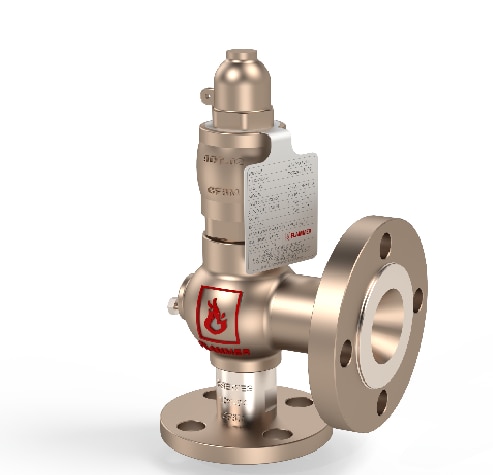 | Pressure Safety Valves Flammer Technologies provides good-quality Pressure Safety Valve solutions that protect industrial equipment, pipelines, pressure vessels and process... View product → |
Frequently asked questions
What happens when process pressure exceeds the safe limit?
A pressure safety valve opens at its set pressure and discharges enough fluid to control pressure below the equipment’s permitted limit. The applicable code determines allowable accumulation above set pressure.
Which relief device fits a vessel, pipeline, tank or blocked-in liquid?
Select the device according to the fluid phase, equipment geometry, discharge destination and overpressure cause. Gas or vapour service often uses a safety valve, liquid service uses a relief valve, and blocked-in liquid requires thermal relief for the trapped volume.
How do you set pressure and size the valve for a real overpressure case?
Start with the protected equipment’s MAWP, identify the governing overpressure scenario, calculate required relieving flow, and use the applicable design code and certified valve capacity. Check backpressure, temperature, fluid properties and allowable accumulation.
When are spring-loaded, balanced-bellows and pilot-operated valves suitable?
Use spring-loaded valves for straightforward applications with manageable backpressure, balanced-bellows valves when variable backpressure could affect set pressure, and pilot-operated valves when high flow capacity or tight operating margins justify their added complexity.
What installation and purchasing checks make protection work in Vadodara plants?
Confirm the datasheet states set pressure, MAWP, relieving temperature, fluid, capacity, inlet and outlet sizes, materials, backpressure limits and certification. Keep discharge piping supported, prevent unintended isolation, provide inspection access and plan periodic testing.
Keywords