A plant needs a flameless vent when a combustible dust or hybrid atmosphere can deflagrate inside confined equipment and a conventional vent cannot discharge safely outdoors. By the end, you will be able to screen your process, distinguish dust hazards from gas hazards, compare protection methods, and request the technical evidence needed for a sound selection.
Key takeaways
- Screen combustible dust, vapour, and hybrid mixtures—not the plant’s size.
- Confirm Kst, Pmax, Pred, vent area, and equipment geometry before selection.
- Use flameless vents indoors when vented flames, pressure, and hot gases cannot reach people.
- Record isolation, detection, inspection, and maintenance actions in the protection plan.
Which Vadodara plants and machines face this hazard?
A small indoor cartridge collector can need protection, while a large plant handling only non-combustible liquids may not. Screen the material and the confinement, not the factory’s size or industry label.
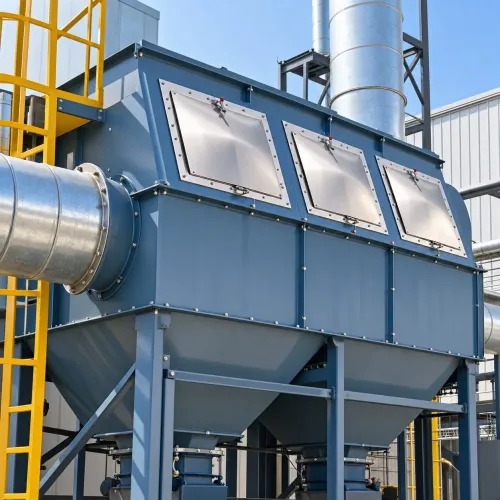
A flameless explosion vent for manufacturing plants in Vadodara is relevant when combustible dust, or a dust-gas mixture, can accumulate inside equipment near workers or occupied rooms.
Screen each location for:
- Aluminium, magnesium, titanium, plastics, pigments, pharmaceuticals, flour, sugar, grain, textiles, wood, biomass and other fine solids
- Dust collectors, cartridge filters, cyclones, mills, grinders, mixers, dryers, silos, hoppers, conveyors, pneumatic-transfer receivers and enclosed process vessels
- Ignition sources such as hot surfaces, bearings, electrical equipment, static discharge and smouldering deposits
- Dust deposits outside the vessel, because cleaning or a primary explosion can lift them into a secondary cloud
| Plant or process | Material needing screening | Enclosed equipment |
|---|---|---|
| Pharmaceuticals and chemicals | Active ingredients, excipients, resins and powders | Filters, mixers, dryers and vessels |
| Food and grain handling | Flour, sugar, starch and grain dust | Silos, conveyors, mills and collectors |
| Plastics, pigments and textiles | Polymer, pigment, fibre and additive dust | Hoppers, grinders and pneumatic receivers |
| Metal processing | Aluminium, magnesium, titanium and reactive fines | Dust collectors, grinders and enclosed transfer systems |
Gas-, vapour- or mist-only hazards require different safeguards. A flameless explosion vent in Vadodara does not become suitable merely because the equipment is indoors; confirm the dust hazard and the device’s tested application.
How do you determine whether the material can explode?
Determine explosibility from the material, how it is dispersed, and the conditions inside the equipment—not from the industry label.
1. Identify every combustible material, including aluminium, magnesium, titanium, pharmaceutical powder, plastic, pigment, food dust and biomass. A metal that is safe as a solid can explode after grinding. Record particle size, moisture content and whether deposits can be lifted into a cloud.
2. Test a representative sample for explosibility, minimum explosible concentration, Kst and Pmax. Do not rely on the safety data sheet alone; it may not reflect your particle size or process. Test accumulated dust from filters, ducts and ledges too.
3. Map where dust becomes confined and meets ignition energy: mills, dryers, mixers, silos, hoppers, pneumatic-transfer receivers and dust collectors. Include deposits outside the primary vessel, because a disturbed layer can feed a secondary explosion.
4. Check for a hybrid atmosphere: combustible dust suspended alongside a flammable gas or vapour. That combination can ignite at lower energy and requires assessment of both dust-explosion and gas-explosion data.
Gas, vapour and mist hazards are not automatically suitable for a flameless dust vent. Use the substance identity, concentration, temperature, pressure and release scenario to select safeguards for those atmospheres.
An industrial explosion protection assessment in Vadodara must also rule out detonation, pressure piling and runaway reactions; a flameless vent normally addresses deflagration, not those rapid pressure-rise events.
Why does an indoor installation change the venting decision?
An indoor machine changes the decision because a deflagration cannot discharge into occupied space. Flame, hot gases, pressure, noise and burning dust can injure workers, damage walls and ignite nearby equipment.
| Option | What it means indoors | Main consequence or limitation |
|---|---|---|
| Outdoor ducting | Routes the explosion discharge outside through a designed path | It moves the hazard rather than removing it; duct strength, pressure loss, bends and discharge clearance need verification |
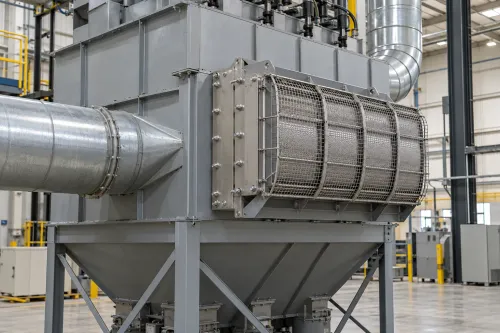
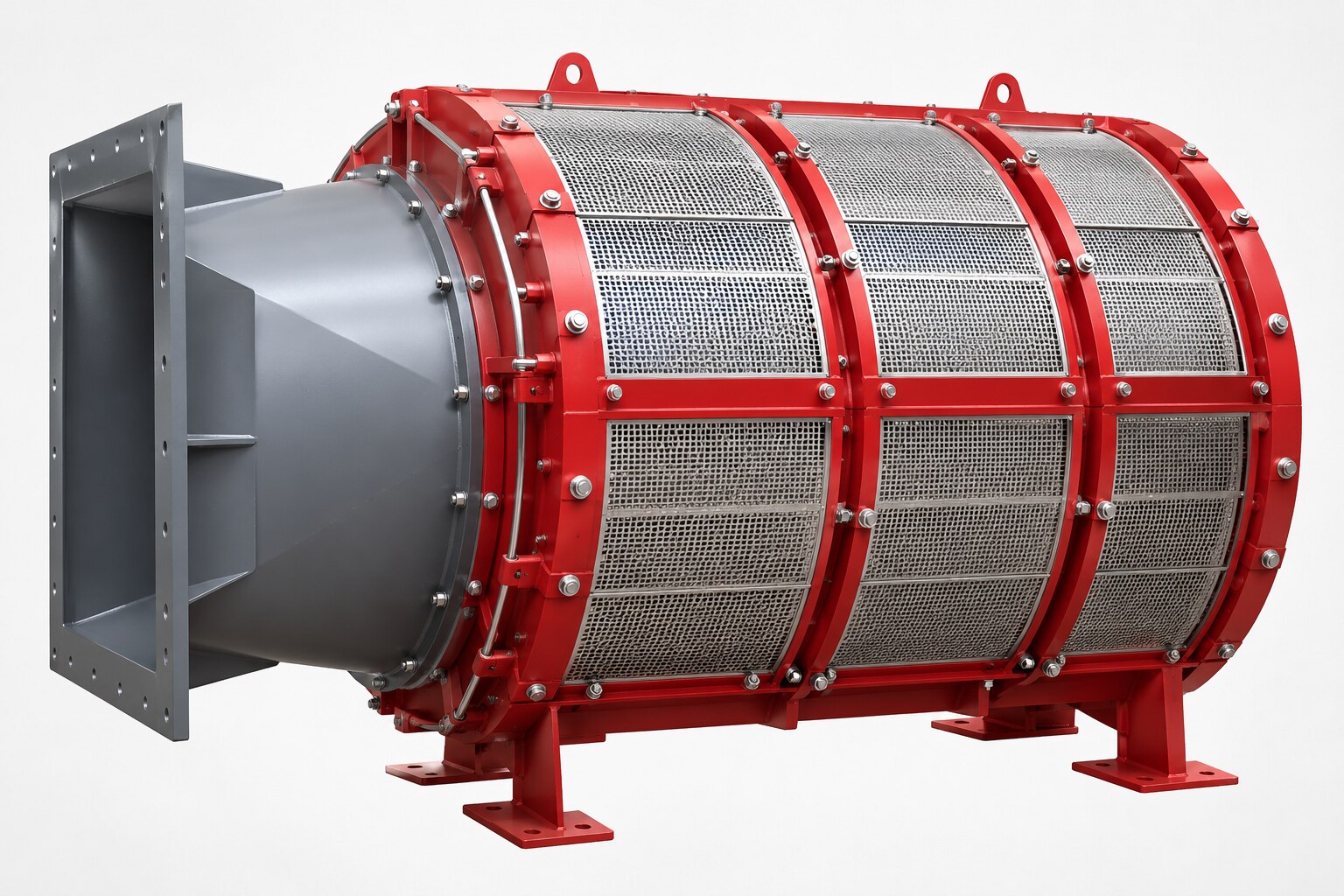
| Flameless vent | Arrests external flame and retains much of the burning dust | Hot gases, pressure, noise and hazardous residue still leave the device; maintain the specified exclusion zone and access for inspection |
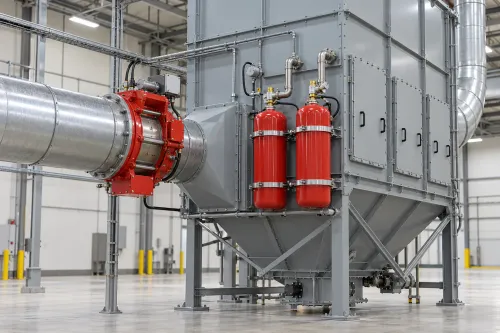
| Suppression | Detects the event and injects extinguishing agent before destructive pressure develops | It needs compatible detectors, agent capacity and fast isolation; it is not interchangeable with venting |
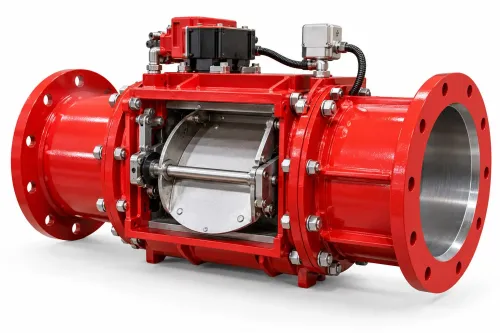
| Isolation and process controls | Uses explosion isolation valves, chemical barriers, non-return devices, segregation, housekeeping and ignition-source control | These measures limit flame and pressure transmission but do not replace a needed pressure-control system |
A flameless vent is useful when no short, safe outdoor route exists, but it does not make an explosion harmless or function as a general-purpose pressure-relief valve. Indoor explosion protection equipment must be coordinated with ducts, transfer lines and common collectors because one vessel’s event can reach connected equipment.
Do not approve it for detonation, pressure piling or runaway reactions without a different engineered safeguard. Check the device’s discharge temperature, residue containment, clearance and manufacturer restrictions against the room, occupancy and dust.
What technical evidence proves that a flameless vent fits?
Approve a flameless explosion vent in Vadodara only when the supplier’s calculation matches your actual vessel and dust data. A generic panel area or “flameless” label cannot prove suitability for an explosion vent for heavy manufacturing.
1. Record the vessel volume, shape, dimensions, operating pressure and temperature, connected ducts, obstructions and interconnected vessels. Check the calculated vent area against Kst, Pmax, initial pressure and temperature, and the required Pred; do not size from diameter alone.
2. Verify Kst and Pmax from representative dust-test results, including particle size, moisture and concentration. For a hybrid mixture, obtain gas-explosion data as well. Confirm that the stated activation pressure suits the vessel’s normal operating pressure and vacuum conditions.
3. Compare Pred with the enclosure’s allowable pressure. Obtain drawings or calculations proving that the vessel shell, doors, supports, nozzles and connected ductwork withstand the reduced pressure and reaction forces.
4. Demand the complete assembly’s test data, not only the vent-panel certificate. Check flame-arresting performance, discharge temperature, pressure reduction, dust-residue containment and the tested dust identity.
5. Check the installation drawing for minimum clearances, discharge direction, occupancy, hot-surface exposure, access for inspection, cleaning method and replacement interval. Manufacturer restrictions can disqualify an indoor location.
6. Name the governing basis: EN 14491 for dust explosion venting, EN 16020 for explosion-venting protective systems, or NFPA 68 where that code governs the project. Flammer Technologies Private Limited can be evaluated against these documents, not against catalogue wording.
Related product
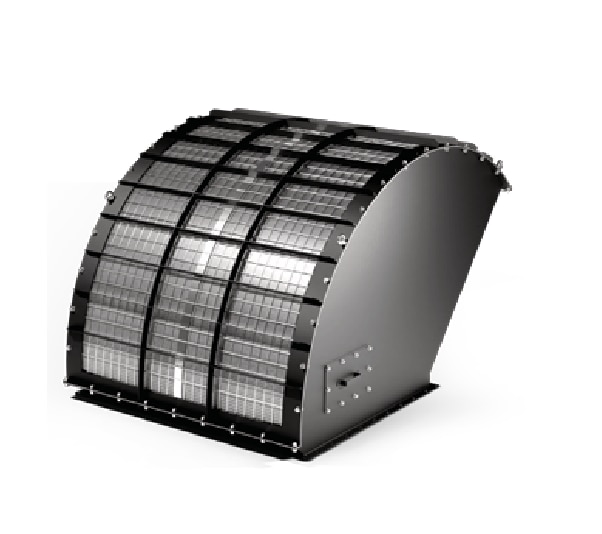 | Flameless Explosion Vent At Flammer, we are manufacturers of Flameless Explosion Vents — specialist safety devices that protect industrial equipment from explosion pressure... View product → |
How should the vent be integrated into the plant protection plan?
Treat the flameless vent as one layer in a coordinated protection system, not as the plant’s only safeguard. A vent reduces pressure by releasing the deflagration through a tested flameless assembly; it does not detect and extinguish the event like a suppression system.
1. Map every connected vessel, duct, transfer line, filter, collector and silo. Specify explosion isolation valves, chemical barriers, non-return devices or physical separation where flame and pressure could travel to another enclosure.
2. Add suppression where the risk assessment requires rapid extinguishing, especially when occupancy, process connections or equipment strength makes venting alone unacceptable. Do not use a flameless vent as protection against detonation, pressure piling, runaway reaction or another rapid pressure rise outside its tested basis.
3. Link the protection system to process interlocks. Stop feeders, mills, fans, conveyors and pneumatic transfer when an explosion detector, suppression system or isolation device activates; prevent restart until inspection and reset are authorised.
4. Control ignition sources with bonding and earthing, temperature monitoring, bearing protection, spark detection, hot-work controls and suitable electrical equipment. A vent cannot compensate for a continuously fed ignition source.
5. Set housekeeping rules for deposits inside and outside the primary vessel, including dust collectors. Define cleaning methods, inspection frequency and permitted accumulation; disturbed deposits can create a secondary explosion.
6. Mark a discharge exclusion zone around each flameless vent using the manufacturer’s tested flame, hot-gas, noise and dust-release envelope. Keep people, combustible stock, air intakes, cables and escape routes outside it, and review the zone after layout changes.
Frequently asked questions
Which Vadodara plants and machines face this hazard?
Machines that collect, convey, mill, dry, mix, or filter combustible dust can require protection. Examples include cartridge collectors, baghouses, silos, hoppers, mills, dryers, and pneumatic conveying systems. Plant size or industry label does not determine the hazard.
How do you determine whether the material can explode?
Test the actual material and operating mixture for combustibility and explosibility. Ask for the dust’s Kst, Pmax, minimum ignition energy, particle-size basis, moisture content, and concentration range. Assess vapour and dust combinations separately when both are present.
Why does an indoor installation change the venting decision?
A conventional explosion vent can release flame, pressure, burning dust, and hot gases into the room. Indoors, that discharge can injure workers or damage nearby equipment, so a flameless vent or ducted outdoor discharge must be evaluated.
What technical evidence proves that a flameless vent fits?
Compare the vent manufacturer’s certified performance with the enclosure volume, strength, operating pressure, Kst, Pmax, Pred, vent area, temperature, and installation layout. Check that the device is approved for the process material and expected explosion conditions.
How should the vent be integrated into the plant protection plan?
Coordinate venting with explosion isolation, spark or ignition control, housekeeping, inspection, maintenance, emergency procedures, and worker training. Document access clearances, discharge zones, inspection intervals, and the response to blocked or damaged components.
Keywords