Pressure systems do not always operate at steady conditions. Compressors start and stop, batch vessels pass through repeated process stages, and utility systems experience pressure fluctuations. These cycles can place recurring stress on a pressure-relief device even when the specified burst pressure is never reached.
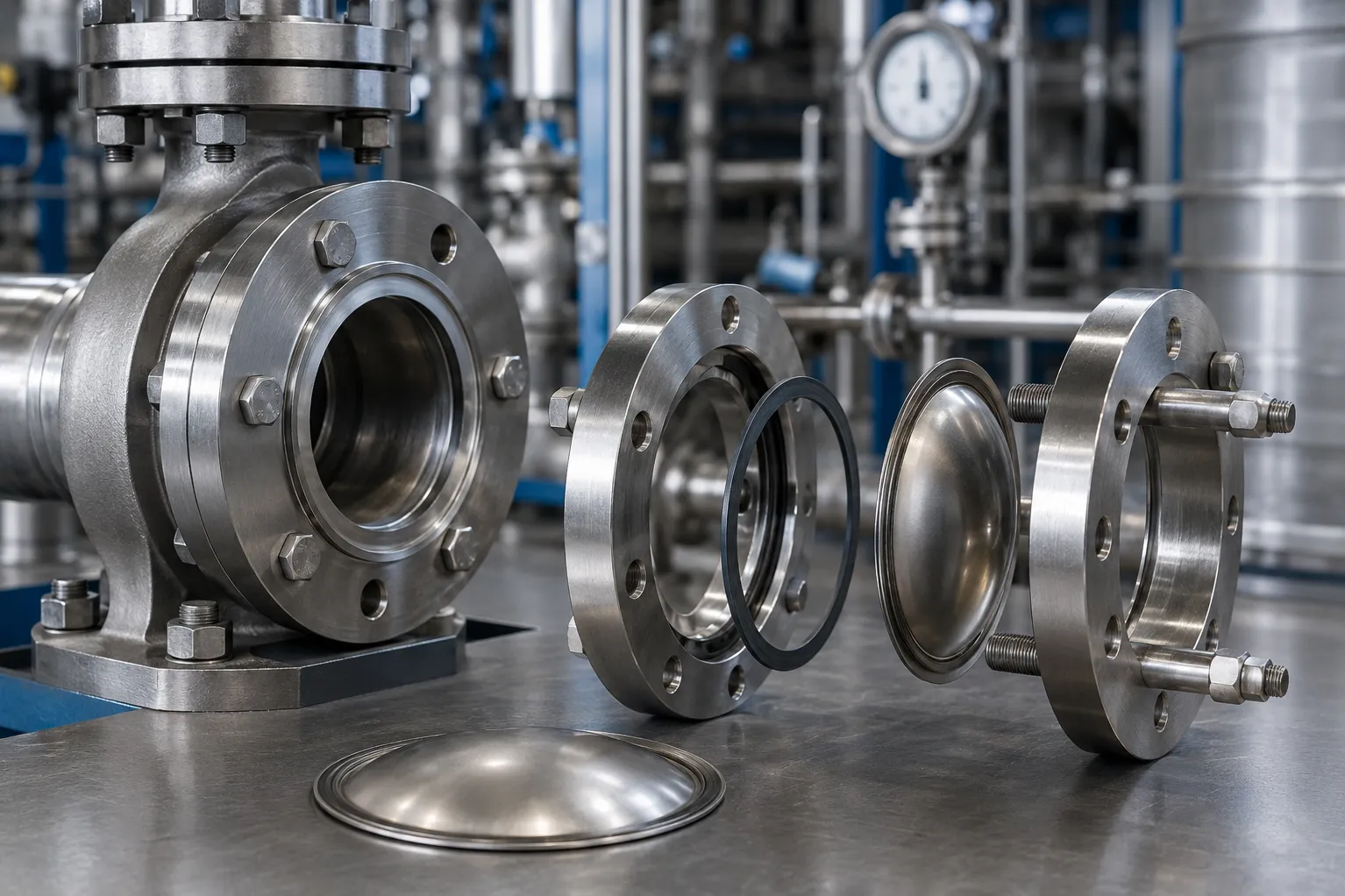
A reverse buckling rupture disc is designed with its dome oriented against the direction of process pressure. During an overpressure event, the dome reverses and opens through a controlled structural action. This operating principle makes the design suitable for many applications requiring resistance to pressure cycling and operation relatively close to the specified burst pressure.
How Reverse Buckling Action Works
Under normal conditions, process pressure loads the convex side of the dome. The geometry provides stability until the pressure reaches the defined activation range. The dome then reverses, causing the disc to open through engineered features associated with the particular design.
The exact opening mechanism varies among products. Some designs use scored patterns, while others interact with holder features. Procurement documents should not assume that every reverse buckling disc has identical fragmentation behaviour, flow characteristics or vacuum resistance.
A reverse buckling rupture disc manufacturer should explain:
- How the disc opens
- Whether it is designed to be non-fragmenting
- Its recommended operating ratio
- Its resistance to full vacuum
- Its sensitivity to pressure cycling
- The required holder configuration
- Its certified or tested flow characteristics
Why Cycling Performance Matters
A disc subjected to pulsation may accumulate mechanical fatigue if its design is unsuitable for the service. Possible sources of cycling include reciprocating compressors, pressure-swing processes, loading operations, cleaning sequences and batch reactions.
The selection review should quantify cycling rather than simply describing it as “frequent.” Engineers should provide the expected pressure range, cycle frequency, start-up transients and planned service life. These details help the manufacturer assess whether the proposed design fits the duty.
Operating Ratio Requires Careful Review
Operating ratio describes the relationship between normal operating pressure and the marked burst pressure under defined conditions. A higher permissible ratio may allow the process to operate closer to the activation pressure, but it should never be treated as a universal value.
Temperature, manufacturing range, pulsation and back pressure can affect the selection. Normal process excursions must also remain within the recommended operating limits. If the system regularly approaches the burst condition, the process design and control strategy may need attention rather than simply choosing a different disc.
Questions to Ask the Manufacturer
Before approval, request clear answers to the following:
- What minimum and maximum burst pressures are available for the required size and material?
- At what coincident temperature is the burst pressure specified?
- What operating ratio is recommended for this exact model?
- Can the disc tolerate full vacuum without additional support?
- Is the design suitable for gas, liquid or multiphase relief?
- What is the expected opening pattern?
- Which holder must be used?
- What inspection or replacement guidance applies after abnormal operation?
A generic statement that the product offers “high performance” is not enough. The response should relate directly to the submitted process conditions.
Installation Still Determines Reliability
Even a correctly selected disc can be compromised by incorrect installation. Reversing its flow direction, using an incompatible holder, damaging the dome or applying uneven flange loading may alter its behaviour.
Maintenance teams should retain the installation instructions and verify disc identity during every replacement. The tag information should match the approved engineering datasheet.
Vadodara’s chemical, pharmaceutical, engineering and process industries often operate equipment with cycling pressure conditions. Working with a reverse buckling rupture disc manufacturer familiar with these applications can improve the quality of technical review. Flammer Technologies Private Limited can assess submitted operating operating data and help customers identify the information needed for a suitable configuration.
The design decision must ultimately form part of the plant’s documented pressure-protection assessment. Reverse buckling technology can offer valuable operational advantages, but only when pressure, temperature, cycling, material and installation conditions are evaluated together.
Keywords