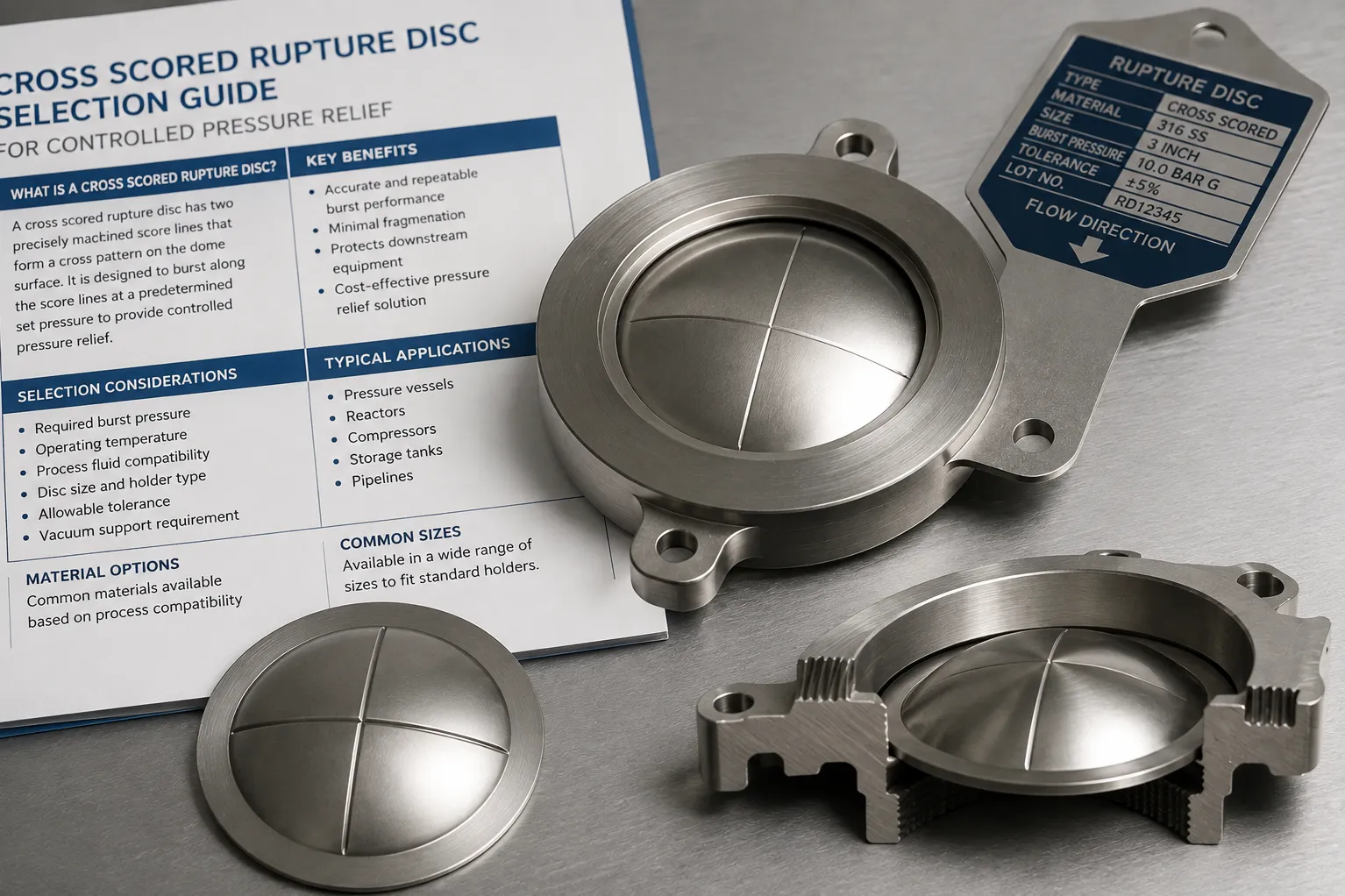
A cross scored rupture disc contains engineered score lines that help determine how the disc opens when the specified pressure condition is reached. The scoring pattern is intended to create defined sections or petals, supporting a controlled opening path and reducing dependence on random tearing.
This type of device can be useful in industrial pressure-protection systems, but the presence of cross scoring does not automatically make every product suitable for every application. Process conditions, material selection, flow capacity and holder design remain central to the decision.
Why the Scoring Pattern Matters
The score depth and geometry influence the structural behaviour of the disc. Under normal service conditions, the disc must remain stable. During an overpressure event, the engineered lines help initiate and guide opening.
Manufacturing consistency is therefore critical. Scoring that is too deep, too shallow or uneven may alter the burst behaviour. Procurement teams should evaluate a manufacturer’s ability to control material, forming, scoring and testing rather than treating the disc as a simple sheet-metal component.
Confirm Forward or Reverse Acting Design
Cross scoring can be associated with different rupture-disc configurations. Buyers should verify whether the offered model is forward acting or reverse buckling because the two principles load the disc differently.
This distinction affects:
- Recommended operating ratio
- Cycling capability
- Vacuum resistance
- Burst-pressure range
- Installation orientation
- Required holder features
The technical datasheet should describe the operating principle clearly. If the product name alone does not establish how it functions, request a sectional drawing or operating explanation.
Evaluate Fragmentation Claims Carefully
One reason users consider scored discs is the possibility of controlled, non-fragmenting opening. This can be valuable where downstream piping, relief valves or process equipment could be affected by loose metallic pieces.
Nevertheless, the buyer should confirm the manufacturer’s stated fragmentation characteristics for the exact model, size, material and burst range. Different configurations may not behave identically.
Where a disc is installed upstream of a pressure-relief valve, the complete combination must be evaluated. Leakage detection, the space between devices and the influence of the disc on flow capacity may all require attention.
Specify the Process Medium
The supplier needs to know whether the protected system contains gas, vapour, liquid or a two-phase mixture. Liquid service may involve different dynamic behaviour from compressible-fluid relief.
Also disclose:
- Viscosity
- Solids or suspended particles
- Corrosive constituents
- Polymerising or crystallising material
- Potential product build-up
- Cleaning or flushing methods
Deposits on the disc can affect performance. If the process is prone to accumulation, the installation arrangement and maintenance frequency may need adjustment.
Verify Pressure and Temperature Data
A cross scored rupture disc should be specified using burst pressure at a coincident temperature. The enquiry should include the complete operating envelope rather than a single temperature value.
Procurement and process teams should confirm:
- Normal operating pressure
- Maximum operating pressure
- Required burst pressure
- Minimum and maximum temperature
- Pressure cycling frequency
- Vacuum exposure
- Downstream back pressure
- Required relief capacity
The marked burst pressure, manufacturing range and system pressure limits must be understood before the purchase order is released.
Review Holder Compatibility
A cross scored disc normally works as part of a matched assembly. The holder positions the disc, maintains the required sealing surfaces and establishes the correct flow direction.
Using an unidentified or incompatible holder can create leakage or unreliable opening. Existing holders in brownfield plants should be verified by model, dimensions and condition rather than by nominal size alone.
Process industries around Vadodara frequently maintain equipment installed during different expansion phases. This makes configuration control especially important. Flammer Technologies Private Limited can review application details for cross scored rupture disc requirements, while final approval should remain with the responsible plant engineering authority.
A controlled opening pattern offers practical benefits only when the disc is manufactured consistently and installed correctly. The best buying decision connects scoring design with process data, documented performance and a compatible holder.
Keywords