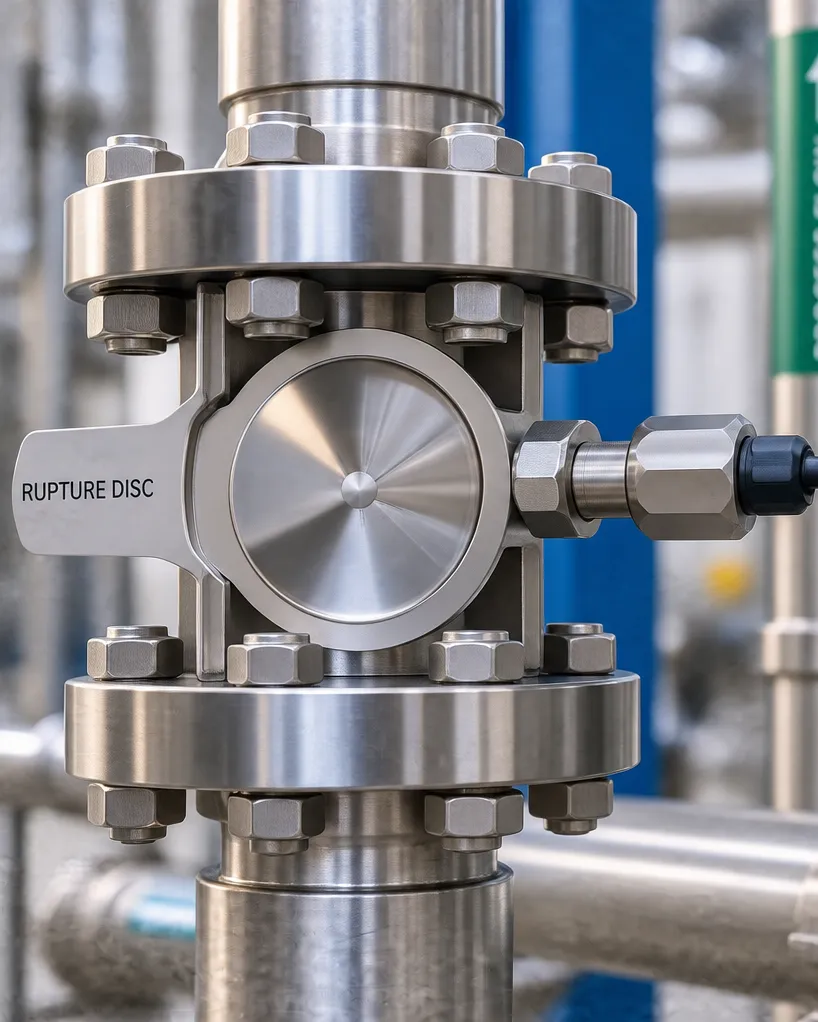
When a rupture disc opens, the pressure is relieved but the plant must still recognise the event and respond. If activation goes unnoticed, process material may continue entering the system, a backup device may remain exposed, or the equipment may restart without the disc being replaced.
A burst alert sensor provides an electrical indication that the disc or venting device has activated. Selecting a burst alert sensor manufacturer requires attention to the sensing principle, hazardous-area requirements, control-system compatibility and maintenance procedure.
Define the Required Response
Before choosing the sensor, determine what should happen after activation. Possible responses include:
- Generate a control-room alarm
- Stop a pump or compressor
- Close an isolation valve
- Shut down process feeding
- Activate an emergency sequence
- Record the event in the plant historian
- Notify maintenance personnel
The required safety integrity and response time should be established through the plant’s risk assessment. A simple status alarm and an automatic protective trip are not the same application.
Understand the Detection Method
Burst indicators may use a circuit that changes state when the disc opens or when relieved pressure physically interrupts a sensing element. The manufacturer should explain the normal condition, activated condition and response to cable failure.
A useful design allows operators to distinguish among:
- Healthy sensor
- Activated sensor
- Open circuit
- Short circuit
- Loss of power
If the system cannot differentiate these conditions, a wiring fault might be mistaken for a genuine burst event or remain undetected.
Check Electrical Compatibility
The sensor’s voltage, current and contact arrangement must match the barrier, relay, input module or monitoring equipment. Procurement teams should not assume that a sensor can be connected directly to every programmable logic controller.
Confirm:
- Electrical rating
- Connection type
- Cable length
- Ingress protection
- Ambient temperature range
- Hazardous-area suitability
- Earthing requirements
- Intrinsic-safety barrier requirements
- Reset or replacement method
Electrical and instrumentation engineers should review the complete loop, not only the field sensor.
Consider the Installation Environment
A burst alert sensor manufacturer needs information about both process and ambient conditions. Outdoor installations in Gujarat may experience heat, monsoon moisture, dust and corrosive industrial atmospheres.
Where the sensor is installed near a relief outlet, it may also encounter released chemical vapour or high temperature. Cable routing should avoid mechanical damage and should not obstruct inspection or disc replacement.
Build Testing Into Maintenance
An alarm device is useful only if its circuit is periodically verified. The maintenance procedure should define how to test the sensor and alarm without compromising the rupture disc.
Testing may include:
- Visual inspection of the sensor and cable
- Continuity or loop verification
- Functional alarm testing
- Confirmation of trip or interlock logic
- Inspection after shutdown work
- Replacement after disc activation where required
Bypasses used during testing must be controlled and removed before the equipment returns to service.
Keep the Sensor’s Role in Perspective
A burst indicator does not relieve pressure and does not prevent an overpressure event. It reports a condition. The rupture disc, discharge path and overall protective design must remain correctly engineered.
Similarly, an alarm should not be used to justify delayed disc replacement. Once a non-reclosing device has opened, the equipment should be made safe, the cause investigated and the correct replacement installed under an approved procedure.
Flammer Technologies Private Limited serves industrial customers from Vadodara and can support enquiries involving rupture discs and associated indication requirements. A complete request should include the device type, electrical area classification, control-system input and intended alarm action.
The most effective burst-detection arrangement combines a compatible sensor with supervised wiring, defined operator response and periodic functional testing. That combination helps transform a mechanical activation event into timely, actionable plant information.
Keywords