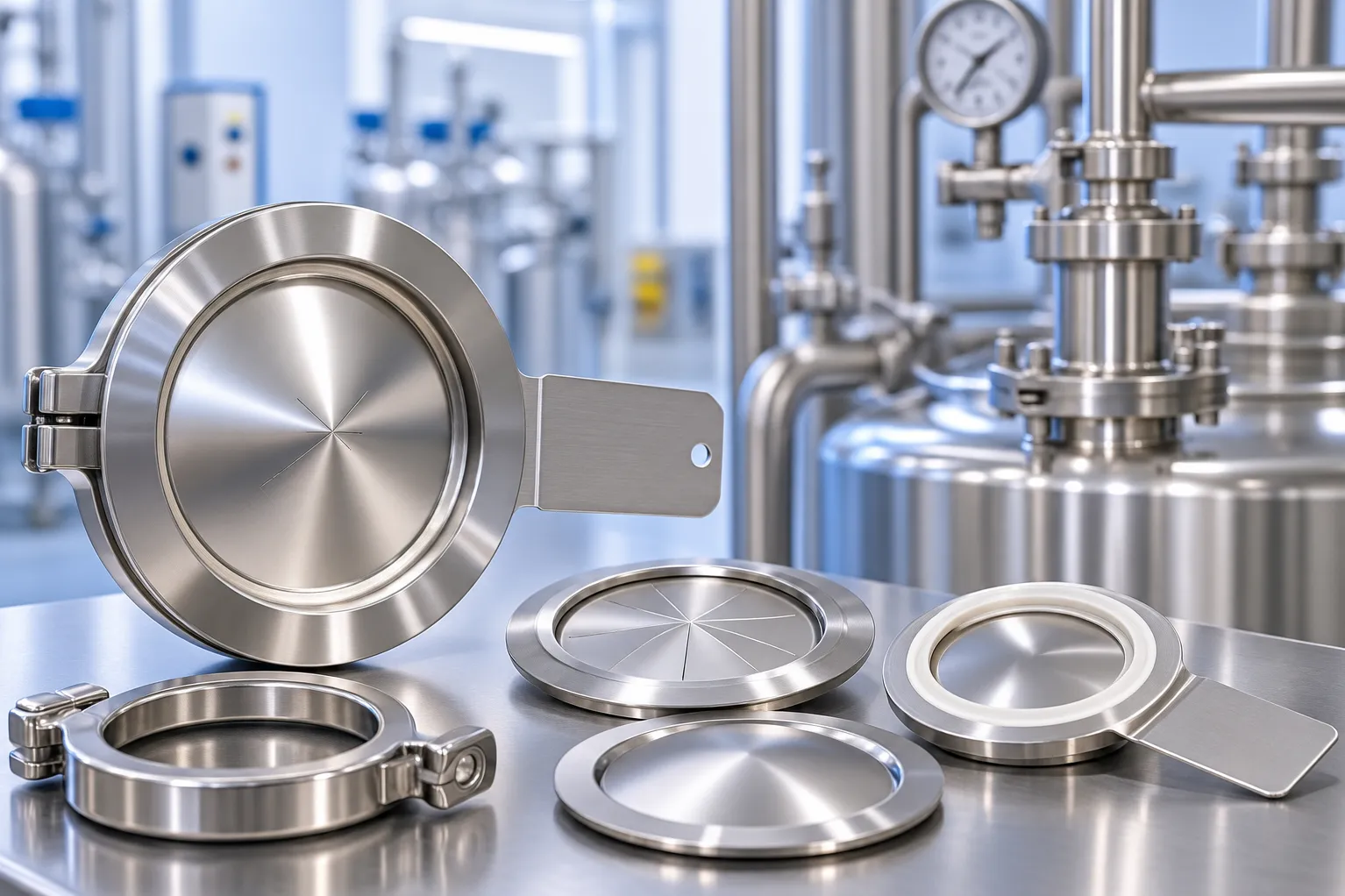
Pharmaceutical, biotechnology, food, dairy and high-purity processing systems need pressure protection without compromising cleanability or product integrity. A sanitary rupture disc is designed for hygienic installations where crevices, retained product and unsuitable surface finishes can create contamination risks.
Selecting a sanitary rupture disc manufacturer requires simultaneous review of pressure-relief performance and hygienic design. A device that satisfies the burst-pressure requirement may still be inappropriate if its process-facing geometry, materials or connection arrangement do not fit the cleaning strategy.
Define the Hygienic Application
Begin by explaining where the disc will be installed. Common locations include:
- Process vessels
- Fermentation systems
- Sterile gas lines
- Clean-steam equipment
- Filtration skids
- Bioreactors
- Food-processing vessels
- High-purity utility systems
The manufacturer should know whether the equipment undergoes clean-in-place, sterilise-in-place or manual cleaning. Cleaning chemicals, temperatures and cycle frequency must be disclosed.
Minimise Product Retention
A conventional holder can introduce recesses where product accumulates. Sanitary assemblies are generally expected to provide a flush or low-dead-space process interface compatible with the equipment connection.
Procurement teams should request dimensional drawings showing the process-facing profile. Check whether the assembly can be installed without creating an unintended pocket and whether its orientation supports drainage.
The hygienic connection type, ferrule standard and gasket dimensions should be stated precisely. Similar-looking clamp connections are not automatically dimensionally interchangeable.
Review Surface Finish and Materials
Process-contact materials should suit both the product and cleaning regime. Stainless steel is commonly used, but the grade and surface condition should be confirmed rather than assumed.
Useful questions include:
- What is the process-contact material?
- Is a surface-finish value specified?
- Are material certificates available if required?
- What gasket materials are compatible?
- Can the assembly tolerate repeated sterilisation temperatures?
- Are protective linings present?
- How is product-contact traceability maintained?
A low roughness value alone does not establish hygienic suitability. Weld quality, geometry, gasket fit and cleanability also matter.
Prevent Installation Damage
Sanitary discs may be compact and relatively delicate. Mishandling, fingerprints, scratches or incorrect clamp loading can damage the assembly or alter sealing.
Installation procedures should specify:
- Correct flow orientation
- Inspection before fitting
- Approved gasket
- Clamp type and condition
- Tightening guidance
- Protection during maintenance
- Replacement after activation
Maintenance personnel should never attempt to flatten, clean aggressively or reinstall a disc that has been mechanically damaged.
Assess Burst Indication Requirements
In automated facilities, rapid confirmation of disc activation may be required to stop a process, isolate equipment or notify operators. A burst indicator can be integrated into the safety and control strategy, provided its electrical characteristics and installation arrangement are compatible with the site.
The sensor is an indication device, not a substitute for pressure-relief engineering. Its failure mode and alarm response should be addressed during the control-system review.
Request a Complete Submittal
A sanitary rupture disc manufacturer should be able to provide a technically clear submittal containing pressure, temperature, material, dimensions, connection details and installation guidance. Project requirements may also call for traceability, inspection records and applicable hygienic documentation.
Vadodara and Gujarat support significant pharmaceutical, chemical and food-processing activity, creating demand for pressure protection suited to clean manufacturing environments. Flammer Technologies Private Limited can be considered during application review when the process conditions and documentation expectations are clearly defined.
Selection should involve process, quality, mechanical and safety representatives. When hygienic geometry, cleaning compatibility and pressure performance are evaluated together, the rupture disc becomes a properly integrated part of the process rather than an isolated safety accessory.
Keywords