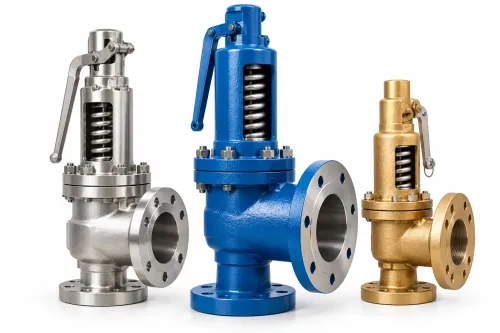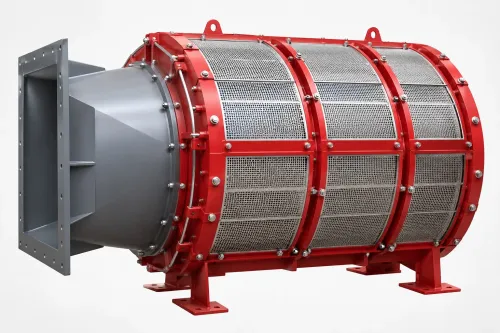
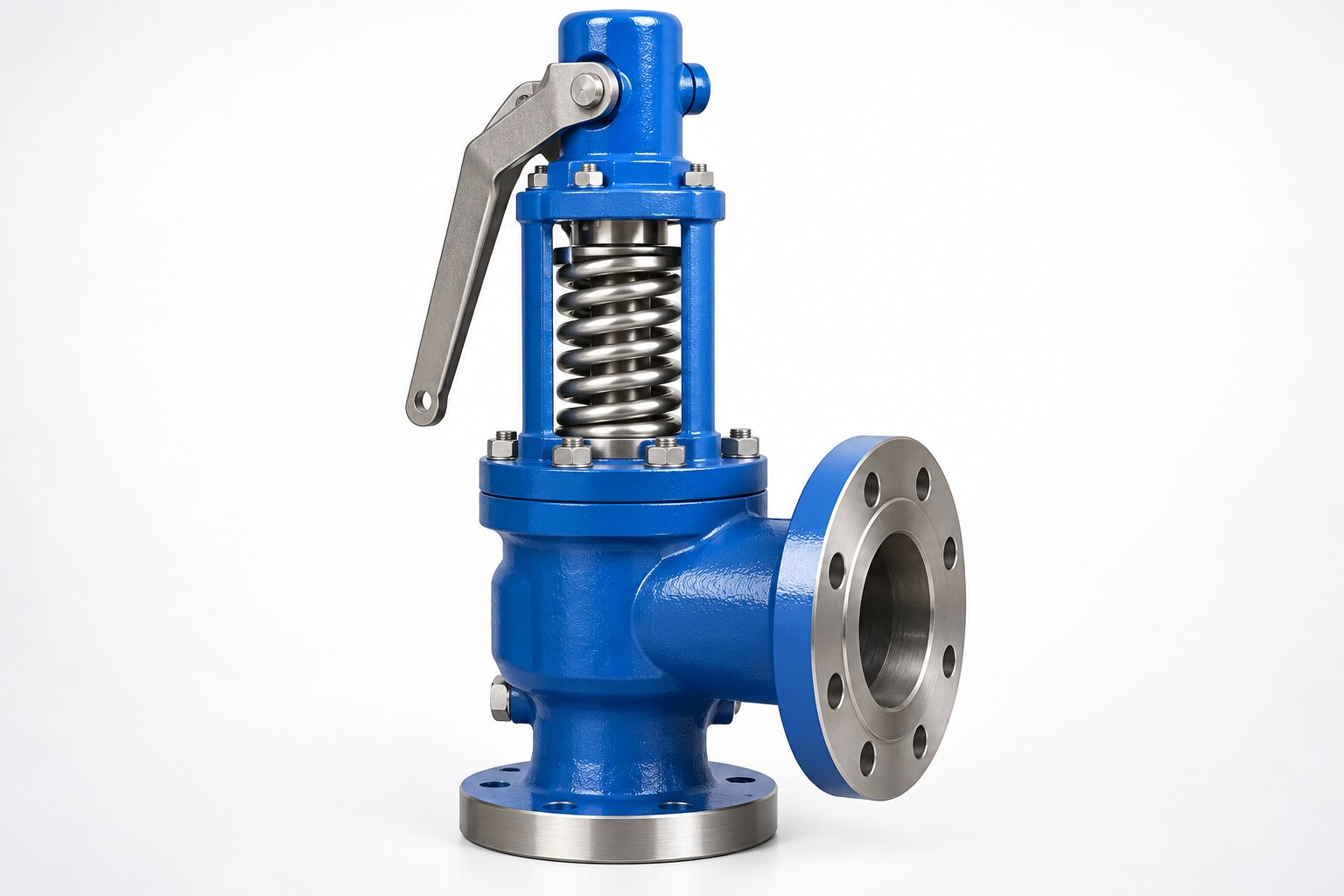
Choosing a valve from a local catalogue is not enough: the correct device depends on the fluid, relieving scenario, backpressure, code limits and discharge capacity. By the end, you will know what information to send suppliers, how to compare valve designs and how to verify that a quotation is technically and legally usable for your plant.
Key takeaways
- Provide set pressure, relieving temperature, flow rate and fluid composition before sizing.
- Choose spring-loaded valves for simpler services and pilot-operated designs for high-capacity relief.
- Check nozzle, trim, materials and backpressure against the process design conditions.
- Request certified test records, material certificates and final set-pressure verification before dispatch.
How a Pressure Safety Valve Opens, Discharges and Reseats
Pressure opens the valve only when the upward force on its disc overcomes the spring force and the force created by outlet backpressure. At set pressure, the disc lifts from the nozzle; a safety valve then opens rapidly, using the flowing fluid’s reaction force to reach its rated lift.
The discharge continues until pressure falls below set pressure by the specified blowdown. The spring then reseats the disc, and the seat must close tightly without damaging contact surfaces.
| Device | Opening and closing behaviour | Correct use | Wrong choice when |
|---|---|---|---|
| Safety valve | Rapid “pop” action; reseats after blowdown | Steam, air and other compressible fluids | You need controlled, progressive liquid discharge |
| Relief valve | Opens progressively as pressure rises | Pumps, liquid lines and hydraulic systems | A gas vessel needs rapid full lift |
| Safety relief valve | Handles either pop or proportional lift, depending on design and service | Mixed or specified gas-liquid duties | The quotation does not state the certified capacity basis |
| Thermal relief valve | Small valve relieves liquid expansion in blocked-in piping | Trapped liquid between isolation valves | Fire exposure or a major overpressure scenario governs |
| Pressure-vacuum relief valve | Relieves positive pressure and admits air under vacuum | Atmospheric storage tanks | A pressure vessel needs high-capacity overpressure protection |
| Rupture disc | Bursts once at its specified pressure and temperature | Non-reclosing protection, corrosive or polymerising service | You need automatic reseating after every event |
A supplier may quote these devices under overlapping names, so compare the datasheet, not the label. For a pressure safety valve in Vadodara, require the manufacturer, model, set-pressure conditions, backpressure basis and certified relieving capacity; a delivery address alone does not prove that the selected device suits your plant.
The Process Data a Supplier Needs Before Sizing the Valve
A supplier needs a defined relieving case, not just the vessel nozzle diameter or normal operating flow. Identify the scenario that governs the design: blocked outlet, control-valve failure, utility failure, external fire, tube rupture or chemical reaction, using the API 521 assessment.
Provide these inputs for each case:
- Fluid composition, vapour or liquid phase, molecular weight or density, compressibility factor, and ratio of specific heats for gas service.
- Normal operating pressure and temperature, set pressure, relieving pressure, allowable overpressure, and relieving temperature.
- Required relieving capacity, with the calculation basis and governing case clearly identified.
- Superimposed and built-up backpressure, discharge destination, and whether the outlet header pressure changes during the event.
- Vessel or pipeline connection size, inlet and outlet sizes, flange standard and rating, face-to-face limits, installation orientation, and available inlet pressure drop.
- Wetted-material requirements, corrosion data, solids, viscosity, polymerising or plugging tendencies, and any low-temperature or high-temperature limits.
- Rupture-disc details when fitted: burst pressure, temperature, manufacturing tolerance, fragment design, compatibility, and the volume between the disc and valve.
The supplier must then show the sizing method, certified coefficient or capacity, and the selected API 526 orifice designation. An API 526 letter alone does not prove adequate capacity.
Do not treat the datasheet set pressure as the nameplate setting automatically. Ask for the cold differential test pressure correction, including operating-temperature and superimposed-backpressure effects, plus the certified test conditions.
Spring, Pilot-Operated and Bellows-Balanced Designs: Which Fits Your Service?
Choose the mechanism from relieving fluid, backpressure and fouling risk—not from the valve’s catalogue name. A safety valve opens rapidly for steam or gas; a relief valve opens progressively for liquid. A safety-relief valve can cover both, but its capacity and set-pressure basis must match the actual phase.
| Mechanism | Strength | Main limitation and suitable service |
|---|---|---|
| Conventional spring | Simple, inspectable and effective for steam, gases and liquids | Built-up backpressure can alter opening and capacity; calculate discharge losses before selection |
| Pilot-operated | Tight operation near set pressure and high capacity with lower spring force | Pilot lines can plug, freeze or polymerise; use clean, compatible gas service and accessible isolation arrangements |
| Balanced bellows | Reduces backpressure effects on spring loading; useful for hydrocarbons or corrosive discharge systems | Bellows needs a suitable bonnet vent and inspection plan; a blocked vent defeats the balance |
Specify body, bonnet, spring, trim, seat and bellows materials against corrosion, temperature, hydrogen service and polymer formation. PTFE, elastomers and soft seats need temperature and chemical compatibility checks; polymerising fluids need short, drainable passages and a cleaning plan.
Compare leakage by the requested API 527 acceptance rate, test medium, test pressure, seat material and valve size. Do not accept “zero leakage” as a technical specification.
Check inlet pressure loss, commonly against the 3% set-pressure criterion, and outlet built-up backpressure. An upstream rupture disk requires a certified valve-disk combination, compatible burst pressure at temperature, controlled fragments and a monitored, vented space between disk and valve; trapped pressure can prevent the valve from relieving.
How to Vet Pressure Safety Valve Suppliers in Vadodara
A Vadodara delivery address proves logistics, not technical authority. When comparing pressure safety valve suppliers in vadodara, ask whether the seller is the manufacturer, a named authorised representative, or only a local sales channel.
Use this procedure before issuing a purchase order:
1. Request the manufacturer’s authorisation letter, validity period, and scope. Confirm the seller appears on the manufacturer’s representative list, then contact the manufacturer using its published domain—not a phone number supplied only in the quotation.
2. Require a technical quotation naming the manufacturer, exact model, nominal size, inlet and outlet connections, materials, orifice, set pressure, relieving capacity, backpressure basis, and applicable capacity certification. A quotation listing only “PSV, 2 inch, 10 barg” is incomplete.
3. Identify the governing API 521 scenario: blocked outlet, control-valve failure, utility failure, external fire, tube rupture, or chemical reaction. Record who sized the valve and who will perform final setting, bench testing, sealing, and calibration.
- Manufacturer and manufacturing location
- Authorised-representative evidence
- Exact model, serial number, size, and drawing
- Material certificates and dimensional inspection
- Set-pressure and seat-leakage test reports
- Test-instrument calibration traceability
- Coating or preservation record
- Capacity-certification evidence
- Required statutory approval, such as Indian Boiler Regulations or PESO, when the service triggers it
An industrial safety valve supplier in vadodara should state cold differential test pressure and temperature corrections, including superimposed backpressure for conventional valves. Flammer Technologies Private Limited is worth evaluating only against this same evidence standard. If you buy pressure safety valve in vadodara, file the documents before approval, not after delivery.
Related product
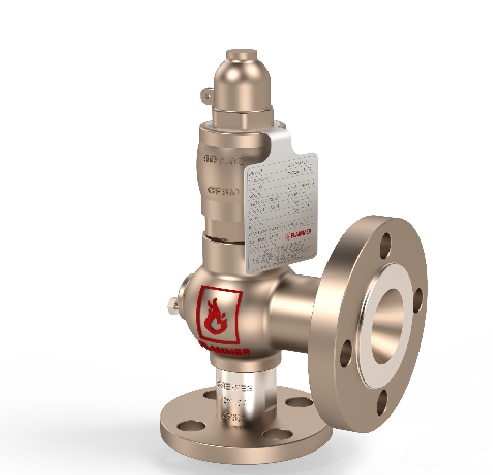 | Pressure Safety Valves Flammer Technologies provides good-quality Pressure Safety Valve solutions that protect industrial equipment, pipelines, pressure vessels and process... View product → |
Standards, Certificates and Final Acceptance Checks
Before acceptance, match the valve to the approved design and statutory route; a delivery address from a pressure relief valve supplier in gujarat proves neither. Confirm the manufacturer, exact model, manufacturing location, authorised-representative status, and the party responsible for final setting and testing.
Request this acceptance file:
- Material certificates for pressure-containing parts, trim and springs, with heat or batch numbers traceable to the valve.
- Hydrostatic pressure-test and seat-leakage results stating the API 527 acceptance rate, test medium, test pressure and seat material. Do not accept “zero leakage” as a substitute.
- Set-pressure test report showing cold differential test pressure, operating-temperature correction and superimposed-backpressure correction where applicable.
- Certified capacity or coefficient, relieving-case calculation, API 526 orifice designation, inlet and outlet sizes, flange ratings and materials. An API 526 letter alone does not prove adequate capacity.
- Calibration certificates, traceable to national or international standards, for test gauges and instruments; add dimensional, coating and preservation inspection records.
- Indian Boiler Regulations documentation for covered boilers or steam service, and Petroleum and Explosives Safety Organisation approval where the equipment, fluid, pressure or installation falls under PESO control.
| Standard or approval | Evidence to verify | Acceptance consequence |
|---|---|---|
| API 526 | Dimensions, flange rating and orifice designation | Confirm fit; verify capacity separately |
| API 527 | Stated leakage class and test conditions | Reject vague “leak-free” claims |
| IBR or PESO | Approval number and applicable scope | Hold installation until the statutory route is cleared |
Frequently asked questions
How does a pressure safety valve open and reseat?
When the force from vessel pressure overcomes the spring force and outlet backpressure, the disc lifts from the nozzle. Flow reaction helps the valve reach rated lift. As pressure falls, the disc returns to the nozzle and reseats at the valve’s blowdown pressure.
What process data does a supplier need to size a pressure safety valve?
Provide the set pressure, required relieving rate, relieving temperature, fluid phase and composition, molecular weight or specific gravity, compressibility, inlet and outlet sizes, allowable backpressure, and the governing design code.
When should you choose a spring-loaded, pilot-operated or bellows-balanced valve?
Use a spring-loaded valve for straightforward services with manageable backpressure. Choose a pilot-operated valve for high flow capacity or tight operating margins. Use a bellows-balanced design when variable or built-up backpressure could affect set pressure or discharge performance.
How can you vet pressure safety valve suppliers in Vadodara?
Check whether the supplier can review process data, provide sizing calculations, identify materials and trim, document testing, and support installation and commissioning. Compare drawings, delivery scope, certificates and after-sales service rather than comparing price alone.
Which certificates and acceptance checks should you request?
Request the approved datasheet, sizing calculation, general arrangement drawing, material certificates, pressure-test report, set-pressure test certificate, calibration details and any required code or third-party inspection records. Confirm the nameplate, flow direction, set pressure, materials, dimensions and tamper seals before acceptance.
Keywords