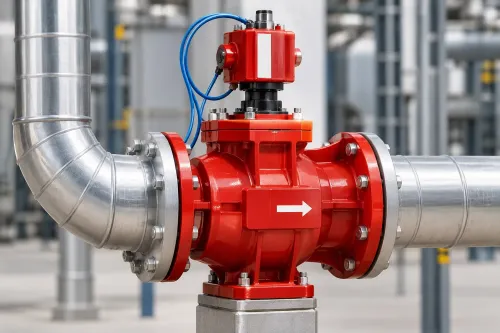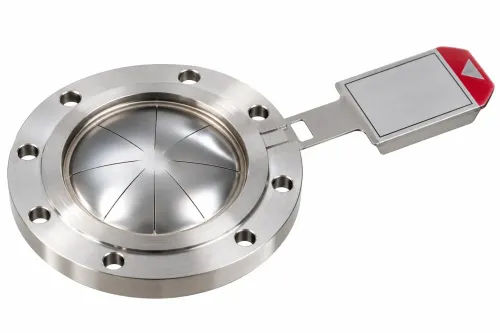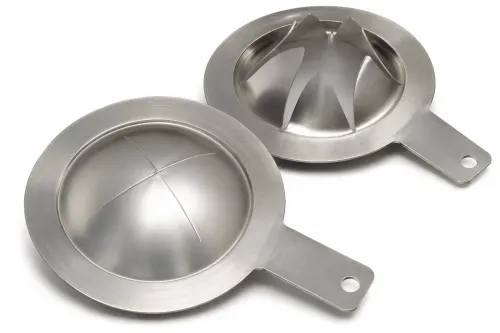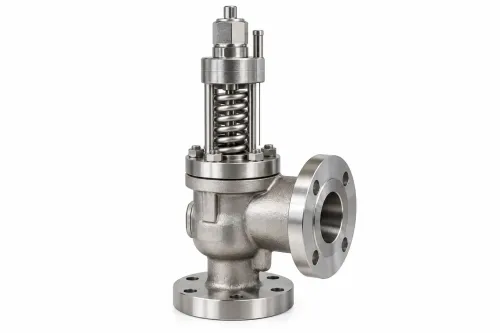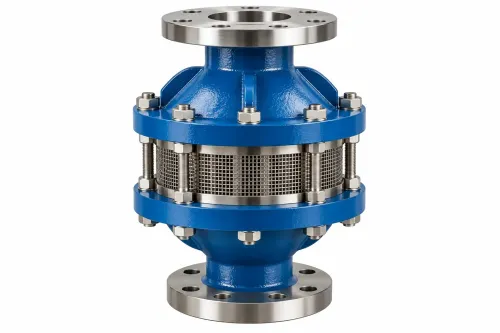
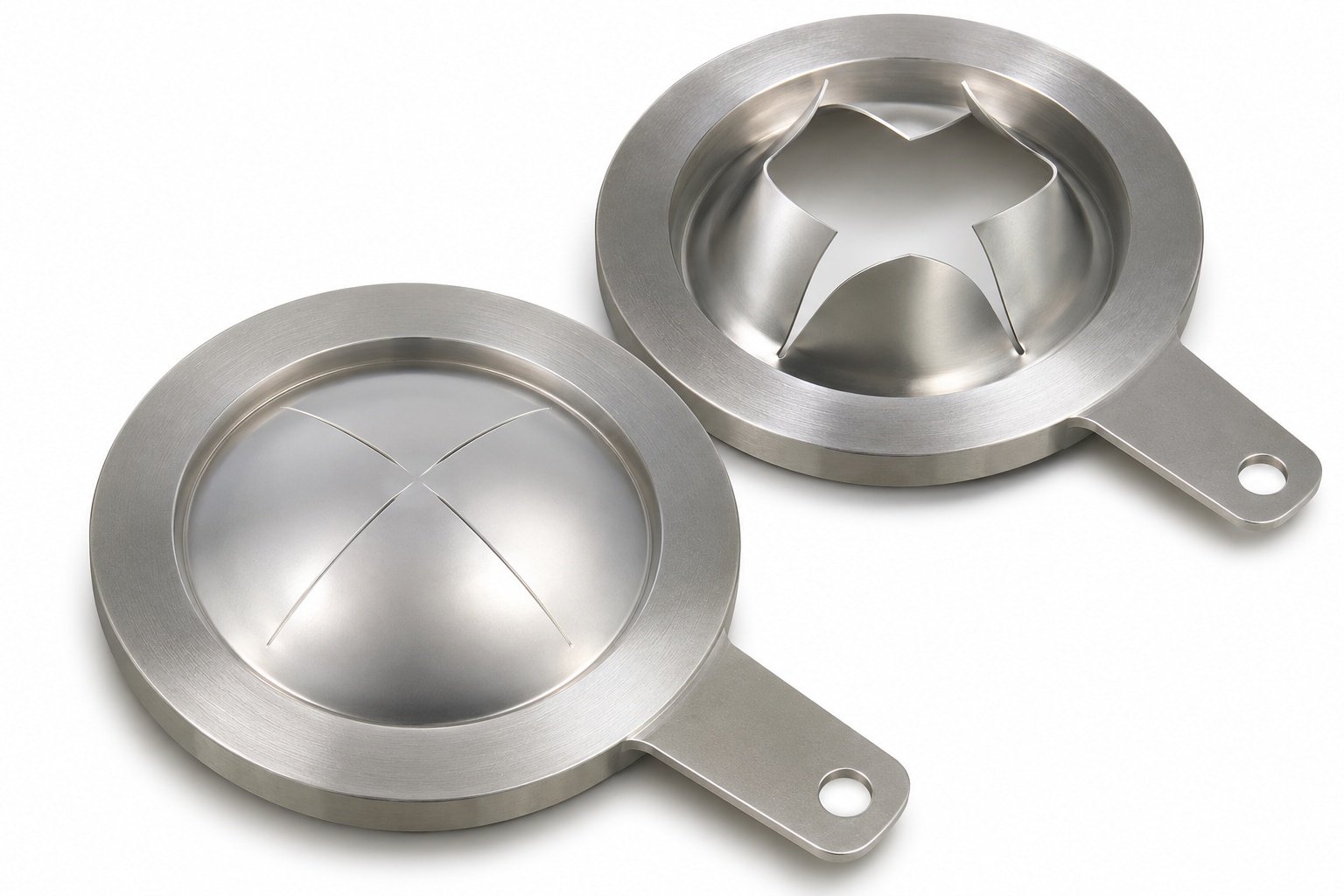
A reverse buckling disc suits a demanding plant when pressure cycles, pulsation, vacuum events, corrosion, or restricted installation space make a conventional forward-acting disc vulnerable. You will be able to screen the application, specify the relief system, compare it with a pressure safety valve, and request the records needed for a sound decision in Vadodara.
Key takeaways
- Confirm process pressure, temperature, fluid phase, and required relief capacity before selection.
- Install the disc with its concave side facing process pressure.
- Compare rupture discs and pressure safety valves against the required response and maintenance needs.
- Verify orientation, burst tolerance, materials, certificates, and installation instructions before ordering.
How a reverse buckling disc opens, and why the geometry matters
A reverse-buckling disc has its concave side facing process pressure. The dome stays stable until the specified differential pressure makes it invert; a knife, score, or opening mechanism then creates the relief path. Install it backward and it can burst early or fail to open correctly.
| Design | How it opens | Practical difference |
|---|---|---|
| Reverse buckling | Dome inverts, then a knife, score, or cutter opens it | Suits high set pressure, cycling, pulsating service, and vibration |
| Forward-acting scored | Pressure pushes the dome forward until scores tear | Simpler, but usually less fatigue-resistant near the set pressure |
| Composite | Layered construction separates, tears, or opens through a designed weakness | Useful for chemical compatibility, low pressures, or special temperature limits |
| Graphite | Brittle graphite fractures under pressure | Corrosion resistance, but fragility and handling limits demand careful installation |
The case for reverse buckling rupture discs for heavy manufacturing in Vadodara is strongest when pressure cycles repeatedly, a pulsating compressor or reciprocating pump creates transients, or installation space is limited. Reverse buckling generally provides stronger fatigue resistance than a forward-acting scored disc, but the permitted operating-to-set-pressure ratio remains specific to the design.
Check vacuum separately. Cooldown, steam-out, pump-out, or condensation can require full-vacuum capability or a vacuum support. Specify a nonfragmenting design when fragments could damage a valve, foul a flare, contaminate a reactor, or reach rotating equipment. These details distinguish suitable heavy manufacturing rupture discs from a visually similar membrane.
What data determines reverse buckling rupture disc selection
Start with the vessel data, not the catalogue. Record set pressure, normal operating pressure, design pressure, coincident design temperature, process fluid, vessel volume, required relief capacity, nozzle size, and allowable overpressure; then calculate the operating-to-set-pressure margin.
- Check that margin against pressure fluctuations, compressor surges, pump transients, and control-valve excursions.
- Provide a pressure-time profile for pulsating compressors, reciprocating pumps, or two-phase flow; static pressure alone can hide fatigue, slug impact, or premature opening.
- Specify whether pressures are absolute or gauge.
Burst pressure at actual temperature determines the effective set point. Material strength, burst tolerance, manufacturing range, temperature derating, corrosion allowance, and absolute-versus-gauge reference can shift it.
Size the disc for the governing case, not the nozzle diameter:
| Scenario | Required check |
|---|---|
| Fire, blocked outlet, valve failure | Relieving fluid, phase, temperature, capacity |
| Gas blow-by, loss of cooling | Inlet or heat-load rate and allowable overpressure |
| Runaway reaction | Reaction rate, two-phase generation, and discharge pressure |
Evaluate constant, built-up, and superimposed backpressure separately. Include common flare-header pressure, flooding, and blockage because backpressure changes the opening differential.
Specify the process-side material, liner, coating, and erosion protection for chlorides, wet chlorine, hydrogen, caustic, acid condensate, sulfides, polymerising fluids, solids, and high-velocity two-phase flow. A high pressure rupture disc in Vadodara also needs review of monsoon moisture, outdoor temperature, storage, and atmospheric corrosion; these conditions affect the holder and gaskets.
This is the core of reverse buckling rupture disc selection.
How to judge suitability across heavy-manufacturing processes
1. Start with the relief scenario, not the disc catalogue. For steel and power-generation plants, check steam, thermal cycling, vibration, and high-temperature materials. For cement plants, check dust loading, abrasion, and fouling that could restrict the opening mechanism.
2. Screen chemical and oil-and-gas service for fluid compatibility, constant and variable backpressure, toxic-release routing, and two-phase relief. Include flare-header pressure, flooding, or blockage in the allowable pressure-loss calculation, and size the discharge path for the governing event.
3. Screen pharmaceutical and food-processing service for cleanability, product-contact materials, hygienic installation, and fragment retention. Confirm nozzle alignment, access for inspection, and whether fragments could enter a reactor, contaminate product, foul a flare, or reach rotating equipment.
4. Treat the disc, holder, gaskets, support components, and opening mechanism as one matched assembly. Do not substitute a visually similar membrane, reuse a compressed gasket, over-torque the holder, or wrinkle the disc during installation; each error can shift burst pressure or restrict opening.
5. Record the assembly as one-shot equipment. After bursting, partial opening, fire exposure, severe overpressure, or mechanical damage, inspect and replace it according to the manufacturer’s instructions. A reverse buckling disc does not reset like a relief valve.
6. Complete the industrial rupture disc suitability review with the operating-to-set-pressure ratio, temperature, vacuum exposure, process compatibility, discharge routing, nozzle alignment, access, and allowable pressure loss. This process-specific check—not the label heavy manufacturing rupture discs—determines whether the assembly is suitable.
When a rupture disc, pressure safety valve, or both make sense
Choose a rupture disc for sealed, corrosive, highly cycling, or rapidly overpressuring equipment; choose a pressure safety valve when recurring relief must end with automatic reset and continued operation. Reverse buckling rupture disc selection starts with that duty, not with a preference for one device.
| Option | Strengths | Best fit and limitation |
|---|---|---|
| Rupture disc | Leak-tight seal, rapid one-time response, full opening, high relief capacity, low routine maintenance | Sealed or corrosive service, rapid transients, or leakage-sensitive equipment; a burst stops protection until replacement |
| Pressure safety valve | Reseats, operates repeatedly, provides controllable blowdown | Recurring relief events where the plant must keep operating; requires inspection, testing, and maintenance |
| Both | Disc protects the valve while the valve provides reset | Use only after assessing the complete assembly, discharge path, governing scenario, and backpressure |
A disc upstream of a valve is justified for corrosion protection, leak prevention, or process isolation. Verify holder gap, flow resistance, pressure loss, leakage monitoring, and the disc’s interaction with the valve’s effective capacity; an acceptable standalone disc can reduce valve capacity.
Check isolation-valve arrangements, common-header pressure, discharge routing, access for inspection, and the consequence of a burst, including fragments, toxic release, or flare overload.
industrial rupture disc suitability depends on the whole path, not the disc alone. A combined arrangement is acceptable only when the governing fire, blocked-outlet, runaway, or other relief case is assessed at actual backpressure. The reverse buckling rupture disc selection is wrong if installation, discharge, or valve interaction leaves insufficient flow area.
What Vadodara buyers should verify before ordering and installing
Before ordering reverse buckling rupture discs for heavy manufacturing in Vadodara, make procurement reproduce the engineering basis on paper. A catalogue pressure label does not prove compliance with the accepted pressure-vessel rules or your purchaser specification.
1. Ask for the applicable ASME BPVC Section VIII basis and, where used, the EN ISO 4126-2 reference. Confirm the accepted code before placing the order.
2. Require the burst-pressure test record at the specified coincident temperature, plus burst tolerance, temperature rating, operating-ratio limit, and whether pressure is gauge or absolute.
3. Obtain material certificates, traceability documents, a dimensional drawing, orientation marking, holder details, gasket specification, and the complete disc-holder assembly identification.
4. Check the operating-to-set-pressure ratio against compressor surges, pump transients, control-valve excursions, and pulsating service. Do not infer this limit from the reverse-buckling design alone.
5. Review Vadodara’s outdoor temperature range, monsoon moisture, storage protection, atmospheric corrosion, discharge routing, nozzle alignment, inspection access, and the holder’s gasket and material suitability.
6. Agree the replacement lead time, stock location, site inspection, installation supervision, and technical support before an outage. Gujarat industrial-cluster logistics reduce downtime only when these arrangements exist in advance.
For a high pressure rupture disc in Vadodara, ask Flammer Technologies Private Limited to match the assembly to vessel data, document the design basis, and support replacement. Do not buy a membrane by appearance or pressure label alone.
Related product
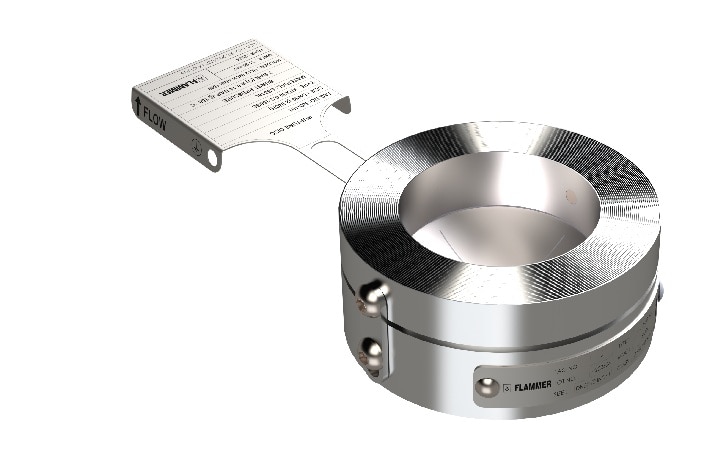 | Rupture Disc Established in 2019 and headquartered in Vadodara, Gujarat, Flammer Technologies Pvt. Ltd. View product → |
Frequently asked questions
How does a reverse buckling rupture disc open?
Process pressure acts on the concave side until the dome inverts at its specified differential pressure. A knife, score, or opening mechanism then creates the relief path.
What data is needed for reverse buckling rupture disc selection?
Provide set or burst pressure, operating pressure, design pressure, temperature, fluid composition, phase, relief capacity, vacuum conditions, materials, and installation details.
When are reverse buckling rupture discs suitable for heavy manufacturing?
They suit applications requiring fast, non-reclosing pressure relief when the process conditions, pressure margin, temperature, corrosion exposure, and required flow capacity match the disc design.
Should you use a rupture disc, a pressure safety valve, or both?
Use a rupture disc for fast non-reclosing relief, a pressure safety valve for controlled reseating relief, or both when the system needs valve protection, leak isolation, or complementary relief functions.
What should Vadodara buyers verify before ordering a rupture disc?
Verify orientation marks, burst-pressure tolerance, material compatibility, temperature rating, relief capacity, holder dimensions, certificates, inspection records, and the installation procedure.
Keywords