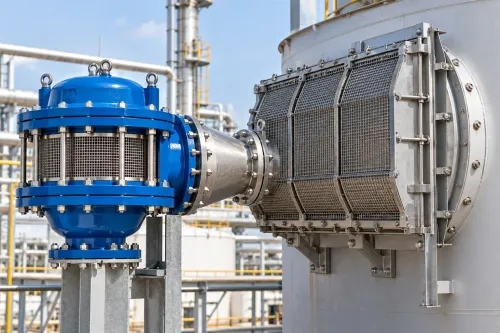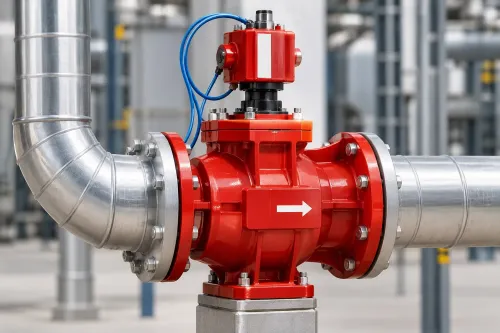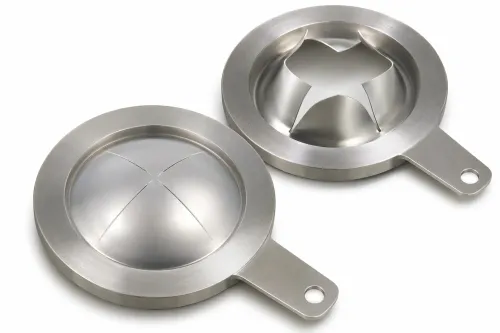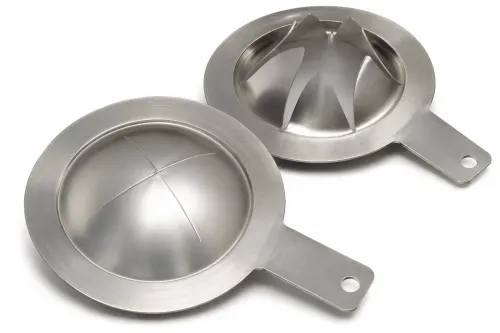
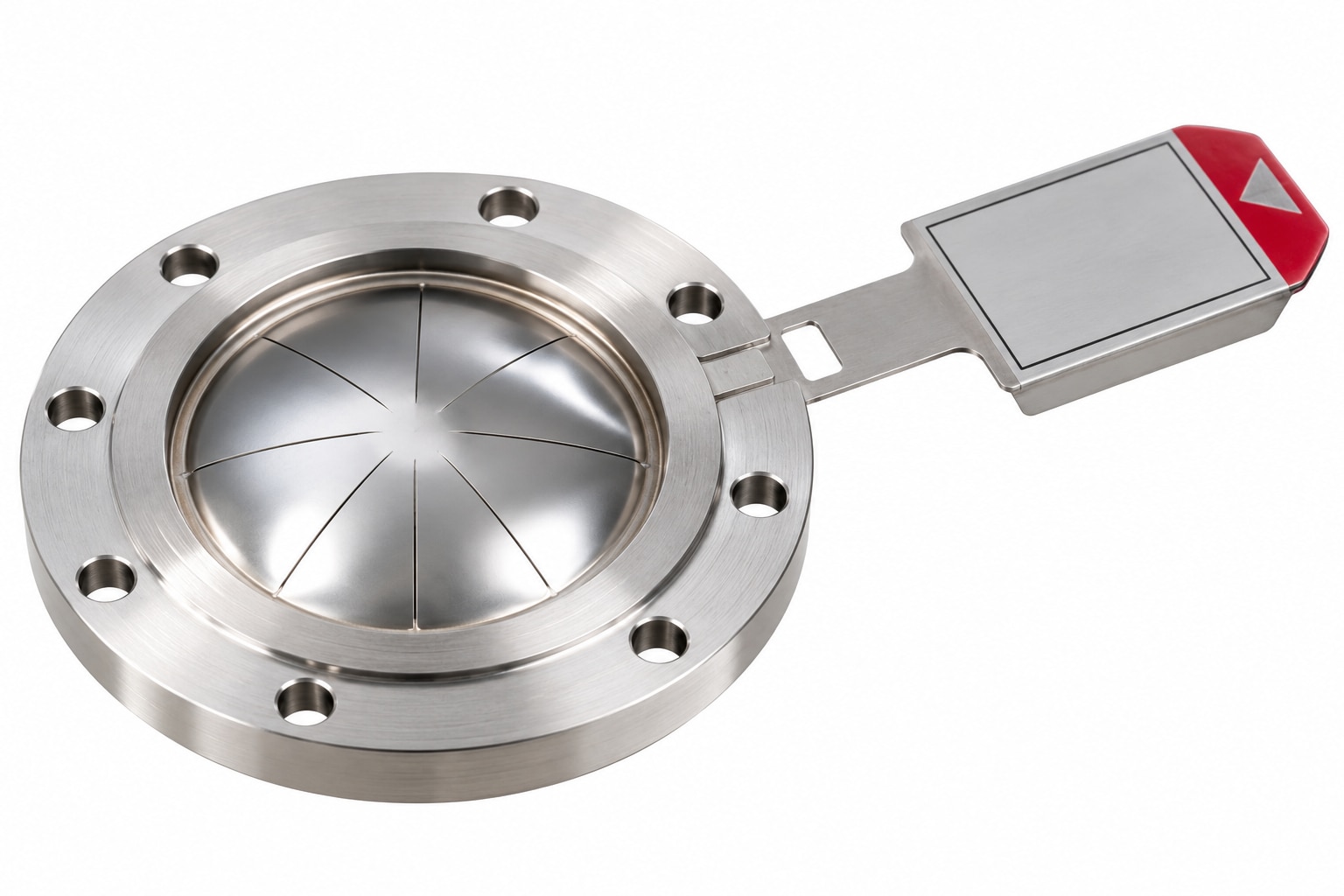
A forward-acting rupture disc does not regulate pressure or close after relieving it; it stretches, fails at a specified pressure and temperature, and creates a discharge path. You will be able to trace that response, separate genuine disc failure from specification or installation problems, and assemble the data needed to assess a low-pressure application.
Key takeaways
- Match burst pressure to the specified temperature, not the vessel’s nominal pressure class.
- Confirm process pressure acts on the disc’s concave side before selecting a forward-acting design.
- Check vacuum, cycling, corrosion, and installation damage before calling a disc failure.
- Document design pressure, operating pressure, temperature, tolerances, and installation details before approval.
What happens when a forward-acting disc reaches burst pressure?
At normal operation, process pressure acts on the concave side of the dome and keeps the forward-acting disc intact. As pressure rises, the tension-loaded membrane deflects and stretches; it opens when the specified burst pressure is reached at its specified temperature. That value matters more than the disc’s nominal pressure class.
1. During the approach, the disc contains the process while pressure cycles, temperature changes, and mechanical loads continue to affect its service life. A set pressure close to normal operating pressure can shorten that life.
2. At burst, tensile failure tears the membrane along its designed opening pattern. The disc may fragment or open as a nonfragmenting panel, depending on its construction.
3. The opening creates a relief path into the vent, flare, or discharge system. The system must handle pressure loss, backpressure, reaction forces, noise, dispersion, and safe termination; correct disc opening alone does not guarantee industrial pressure event protection.
4. As inventory leaves, vessel pressure falls and the relief flow decreases. A rupture disc normally does not reseat, so it cannot regulate the remaining pressure or restore containment.
After the event, isolate the equipment under an approved procedure, control any released material, and replace the disc after finding the cause. A sound forward acting rupture disc response can be undermined by vacuum, reverse pressure, pulsation, corrosion, handling damage, or an incorrectly assembled holder, so inspect those conditions before blaming the disc.
Why pressure direction and low set pressure change the disc choice
A forward-acting disc stretches under pressure on its concave side and opens by tensile failure; a reverse-buckling disc first becomes unstable and flips or buckles before its scored section opens. That distinction matters at low set pressures, where normal operating pressure sits close to the burst value and small disturbances consume the margin.
| Option | Pressure event | Low-pressure implication |
|---|---|---|
| Forward-acting disc | Pressure stretches the dome until tensile rupture. | Simple response, but greater sensitivity to corrosion, fatigue, handling damage, vibration, and installation stress. |
| Reverse-buckling disc | Pressure makes the dome invert before the opening feature ruptures. | Buckling action can provide a more stable response when the set pressure is close to operating pressure. |
For forward acting rupture discs for pressure problems in Vadodara, compare the specified burst pressure at the coincident temperature, manufacturing design range, and burst tolerance—not the nominal pressure class. A low pressure rupture disc in Vadodara also needs a vacuum and reverse-pressure review.
Check pressure pulsation, unsupported piping loads, holder alignment, bolt tightening, and handling marks. Reverse pressure or vacuum can damage a forward-acting dome before positive pressure reaches its set point.
If the disc opens, it normally does not reseat; the vent path must safely handle discharge, and the disc requires replacement after the initiating event is investigated.
Which pressure and temperature figures determine a safe selection?
A safe selection starts with the vessel’s required burst pressure at the coincident relieving temperature, not the disc’s nominal pressure class. Compare that value with normal operating pressure, maximum operating pressure, design pressure, and the allowable operating-to-burst-pressure relationship stated for that disc design and applicable code.
| Figure to compare | What it tells you | What can go wrong |
|---|---|---|
| Required burst pressure | Pressure at which the disc must open at the specified temperature | The disc opens too late and the vessel exceeds its allowable pressure |
| Normal and maximum operating pressure | The pressure the disc must withstand repeatedly | A close margin causes fatigue, premature opening, or rupture disc pressure failure |
| Marked burst pressure and temperature | The tested burst value at a stated temperature | Using the marked value at another temperature gives a false margin |
| Manufacturing design range and burst tolerance | The permitted production variation around the specified burst pressure | A nominal value alone hides the lowest credible opening pressure |
| Relieving temperature | The disc material strength during the pressure event | Heat can lower burst pressure; cold can change ductility and response |
| Backpressure and vent-line loss | The pressure acting on the downstream side after opening | The disc opens, but inadequate capacity creates unsafe vessel pressure |
Check process chemistry against the disc material, including concentration, contaminants, cleaning chemicals, temperature, and upset conditions. Corrosion, hydrogen effects, erosion, pinholes, and fatigue cracking can lower actual strength before the marked burst pressure is reached.
For gas or vapour service, add discharge reaction force, flare or vent capacity, noise, dispersion, and termination location to the selection review. A disc that opens at the intended figure can still create a hazardous pressure event downstream.
How to tell a true disc failure from damage or installation error
Treat a rupture as an investigation, not proof that the disc was defective. A true disc failure matches the specified burst pressure, coincident temperature, and expected opening pattern; a leak or early opening can instead result from fatigue, vacuum, corrosion, thermal shock, installation stress, or discharge backpressure.
1. Preserve the evidence. Photograph the disc, holder, fragments, markings, gasket, and discharge piping before cleaning or replacement. Record the burst tag, operating pressure and temperature, alarm history, and the exact time of the event.
2. Reconstruct pressure cycling. Compare normal operating pressure, pulsations, compressor or pump surges, and repeated start-up cycles with the disc’s manufacturing design range. Fatigue can weaken a forward-acting disc without one dramatic overpressure.
3. Check reverse loading. Look for vacuum during draining, cooling, steam-out, or blocked venting, plus reverse pressure from a connected system. A forward-acting disc can deform or leak under loading that never appears on the positive-pressure record.
4. Examine material loss and temperature shock. Map corrosion, pitting, erosion, pinholes, and cracking, then compare process chemicals, contaminants, cleaning agents, and upset temperatures with material compatibility. Rapid heating or cooling can damage the membrane.
5. Verify assembly and discharge. Confirm disc orientation, holder alignment, gasket position, bolt torque, piping support, vibration, outlet size, backpressure, and unobstructed discharge. A leaking holder is not a disc rupture.
This evidence-based sequence separates genuine forward acting rupture disc response from installation or service damage and supports industrial pressure event protection without assigning blame prematurely.
What to document before approving a low-pressure installation in Vadodara
Approval starts with a completed design basis, not a requested burst pressure. For a low-pressure rupture disc in Vadodara, record the vessel MAWP, operating pressure range, vacuum cases, credible overpressure scenarios, required burst pressure, coincident temperature, manufacturing design range, and burst tolerance.
- Identify the protected equipment, nozzle size, holder type, flow direction, relief-area calculation, and selected design code. Attach the vessel nameplate or design drawing.
- Describe the process fluid, concentration, contaminants, cleaning chemicals, upset chemistry, and material-compatibility check. Include corrosion, erosion, hydrogen exposure, and expected thickness loss.
- State normal pressure cycling, pressure pulsation, vibration, thermal shock, heat tracing, and shutdown conditions. Check reverse pressure and vacuum exposure; a forward-acting disc can fail below its specified positive burst pressure.
- Map the relief route from the disc to the discharge destination. Record outlet diameter, equivalent length, fittings, allowable backpressure, reaction loads, drainage, vent orientation, and personnel exclusion controls.
- If a safety valve sits downstream, document interspace monitoring, leakage detection, backpressure control, and how the valve will sense vessel pressure after disc rupture.
- Add storage and installation conditions, including monsoon humidity, outdoor temperature, utility-air or steam tracing, flange alignment, torque values, and inspection records.
Flammer Technologies Private Limited can review this completed basis against the proposed disc, holder, relief route, and operating conditions. Keep the review record with drawings, calculations, material certificates, and the applicable Indian statutory requirements.
Related product
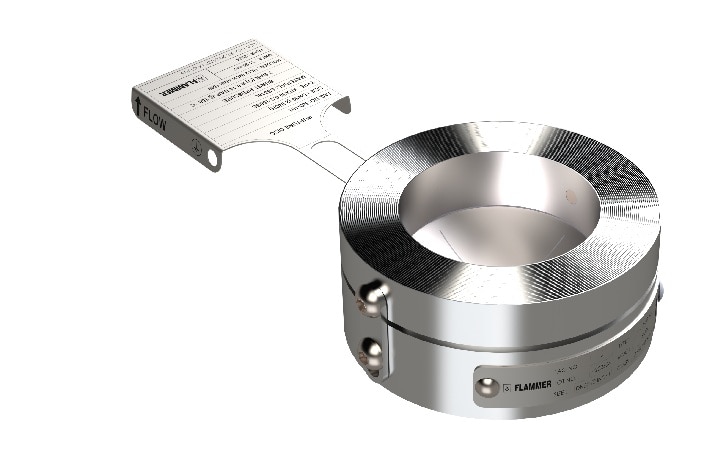 | Rupture Disc Established in 2019 and headquartered in Vadodara, Gujarat, Flammer Technologies Pvt. Ltd. View product → |
Frequently asked questions
What happens when a forward-acting disc reaches burst pressure?
Pressure acts on the disc’s concave side until the tension-loaded membrane deflects and stretches. At the specified burst pressure and temperature, the disc opens to relieve pressure.
Why do pressure direction and low set pressure change the disc choice?
A forward-acting disc relies on pressure loading from the concave side. Low set pressure leaves less margin between normal operation and burst pressure, so operating pressure, burst tolerance, cycling, vacuum conditions, and pressure direction must be checked together.
Which pressure and temperature figures determine a safe selection?
Record the required burst pressure, specified burst temperature, normal operating pressure, maximum operating temperature, burst tolerance, design pressure, and any vacuum or backpressure condition. The burst value applies at its specified temperature.
How can you tell a true disc failure from damage or installation error?
Inspect the opened membrane, holder seating, gasket surfaces, fasteners, flow direction, and handling marks. Compare the physical evidence with the stamped burst rating, temperature, installation orientation, and operating history.
What should you document before approving a low-pressure installation in Vadodara?
Document the vessel or line design pressure, normal and maximum operating conditions, required burst pressure and temperature, process fluid, corrosion risks, vacuum or backpressure, disc orientation, holder details, installation records, and inspection findings.
Keywords