
A burst-alert sensor tells you that an explosion vent has ruptured or moved, but it does not size the vent, measure Kst, or prove that pressure and flame were discharged safely. By the end, you will be able to compare sensing principles, specify the electrical and mechanical installation, and define the alarm response for each dust-handling enclosure in your Vadodara facility.
Key takeaways
- Use break-wire, magnetic, proximity, pressure or piezoelectric sensors for defined detection tasks.
- Select sensor mounting for each enclosure’s vent movement, temperature, dust and cleaning conditions.
- Interlock the burst signal with alarms, controlled shutdowns and safe vent-discharge arrangements.
- Record commissioning tests, sensor condition, vent details and every post-burst inspection.
What a burst-alert sensor detects and how it is mounted
A burst-alert sensor detects vent-panel rupture, movement, or a pressure event—not explosion severity. Break-wire or conductive-loop devices open their circuit when the membrane tears. Magnetic or reed switches and proximity sensors operate when panel movement separates a magnet or changes the sensing gap. Pressure-sensitive and piezoelectric detectors respond to a pressure transient.
A movement sensor may alarm after opening begins; a pressure switch needs discrimination from normal process-pressure excursions. Neither alarm threshold is automatically the vent opening pressure.
| Device | Detects | Does not prove |
|---|---|---|
| Burst-alert sensor | Panel rupture, displacement, or local pressure transient | Pmax, Kst, Pred, or successful relief |
| Rupture-disc monitor | Rupture-disc condition | Explosion vent suitability |
| Pressure switch or transmitter | Set pressure or measured pressure | Panel movement or safe discharge |
| Burst indicator or microswitch | Local mechanical indication or contact change | Explosion severity |
| Plant-wide gas or flame detector | Gas concentration or flame at its sensing location | Vent-panel rupture |
Mount the sensor on the vent frame or an approved external bracket. Do not drill, clamp, crease, preload, obstruct, or touch the panel where contact could restrict movement. For dust explosion vent monitoring, route cables away from the discharge path and protect them against abrasion and vibration.
- Use sealed cable glands and a cable jacket suited to dust, monsoon humidity, and washdown.
- Keep dust from settling on the sensing gap, loop, or connector.
- Confirm the vent supplier’s drawing before a retrofit; the sensor must not alter certified panel movement or performance.
- Require the sensing principle, alarm threshold, reset method, and fault indication in the purchase specification for burst alert sensors for explosion vents.
Choosing sensors for each Vadodara dust-handling enclosure
Specify each protected item individually: bag filter, silo, hopper, mixer, mill, bucket elevator, conveyor and every other enclosure. Volume, vessel strength, dust explosibility, Kst, Pmax, Pred, vent area, orientation and isolation needs differ; one sensor on a common exhaust line does not monitor every enclosure.
| Option | Best fit | Main selection concern |
|---|---|---|
| Break-wire or conductive loop | Bag filter, silo, hopper | Direct rupture detection; dust and moisture can affect continuity |
| Magnetic/reed or proximity switch | Silo, hopper, conveyor | Panel movement; allow horizontal or vertical travel without restriction |
| Pressure-sensitive or piezoelectric detector | Mill, mixer, elevator | Pressure-transient discrimination and vibration resistance |
For explosion vent sensor options in Vadodara, assess elevator vibration, mill shock, dust loading, corrosive dust, high ambient temperature, UV exposure, washdown and monsoon moisture. Choose the sensing principle, enclosure and mounting arrangement for that environment, not merely for the dust name.
Require the purchaser to answer these electrical questions:
- Is the supply voltage specified, or is passive loop operation required? Is the output a relay or solid-state contact, normally open or normally closed, and two-wire or four-wire? Is there a local indicator?
- What IP rating, operating-temperature range, corrosion resistance, cable-gland size and gland material apply? Is reset manual or automatic?
- Does dust explosion vent monitoring supervise open circuit, short circuit, power loss and communication loss? Display separate states for vent intact, vent burst, sensor fault and maintenance bypass.
An IP rating does not prove combustible-dust suitability. Check the IEC 60079-10-2 zone, dust group and accepted protection method, including intrinsic-safety barriers where required.
Building the alarm and shutdown sequence after a vent burst
A vent-burst report must trigger a defined plant response, not merely an annunciator. Use burst alert sensors for explosion vents to provide local visual indication, then transmit the condition to the PLC, DCS or SCADA.
1. Show “vent open” locally at the protected equipment. A passive vent has no electrical alarm; a vent with a local indicator only reports the condition at the equipment.
2. Send the sensor contact to the PLC, DCS or emergency-shutdown system. Display the affected bag filter, silo, hopper, mill or other enclosure by name, not as a generic “dust alarm.”
3. Stop the relevant feed, conveyors and upstream equipment, then inhibit automatic restart. Require an authorised person to investigate and reset the sequence.
4. Close connected isolation valves where provided. Isolation is a separate protection function: the sensor does not stop flame or pressure propagation through ducts, and one sensor on a common exhaust line does not monitor every protected enclosure.
5. Direct personnel away from the vent-discharge zone and record the alarm, shutdown, valve position, operator response and reset time.
Use alarm voting when several sensors protect one function, define reset authority, lock maintenance bypasses behind permit control, and choose fail-safe logic for broken wires, lost power and communication failure. Commission the complete dust explosion vent monitoring chain by simulated actuation: sensor contact, annunciation, shutdown, isolation, event recording and manual reset.
Do this without rupturing a production panel.
Matching the sensor, vent assembly and discharge arrangement
Treat the vent and sensor as one engineered assembly, not two interchangeable purchases. Compatibility depends on the vent design, panel material, frame geometry, activation or burst pressure, temperature rating, certified vent area and mounting orientation.
| Supply status | Evidence to require | Main risk |
|---|---|---|
| Factory-fitted | Assembly identification, sensor datasheet and reset procedure | Changing the panel can void the tested protection basis |
| Approved retrofit | Written retrofit limits, bracket or interface drawing and mounting instructions | Drilling, clamping, creasing or preloading can restrict panel movement |
| Separate instrument | Vent calculation, independent sensor specification and interface drawing | A sensor can report rupture without proving adequate relief |
A replacement panel must retain the original certified area, pressure, temperature rating, material compatibility and orientation. Replacing only the sensor while installing a different membrane can change opening behaviour and reduced-pressure performance. Ask suppliers of explosion vents with burst alert sensors in vadodara to identify the complete approved combination.
Route flame, hot gases, the pressure wave and expelled dust away from workers, platforms and adjacent equipment. Never discharge into an undersized duct or building space.
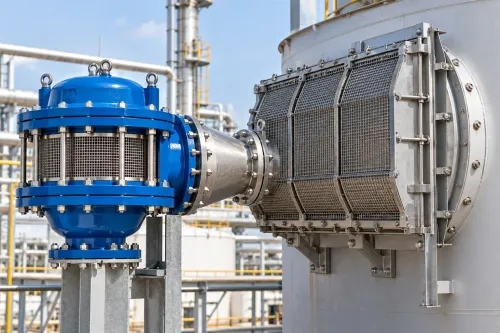
Indoor equipment needs a tested external flame-arresting or flameless assembly when safe outdoor discharge is unavailable; an arbitrary mesh, filter, bend or weather hood adds resistance and can invalidate the tested design.
Compare explosion vent sensor options in vadodara against the vent calculation and site conditions. Flammer Technologies Private Limited belongs in that comparison only when its documented assembly, retrofit limits and discharge arrangement match the installation, rather than treating its sensor as a standalone instrument.
Related products
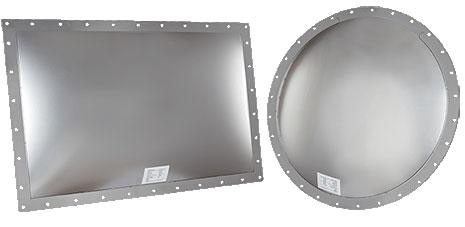 | Explosion Vents At Flammer, we are manufacturers of Explosion Vent — purpose-built passive safety devices designed to protect your industrial equipment, your... View product → |
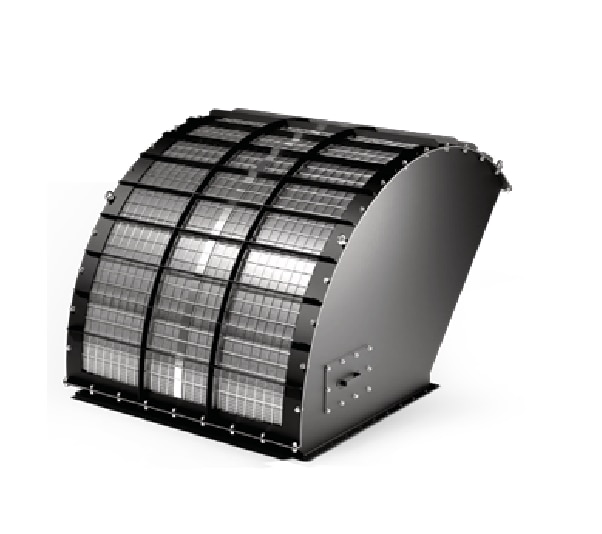 | Flameless Explosion Vent At Flammer, we are manufacturers of Flameless Explosion Vents — specialist safety devices that protect industrial equipment from explosion pressure... View product → |
Commissioning, inspection and records that keep monitoring credible
Inspect the vent at the defined interval and after any process upset. Look for corrosion, dents, loose fasteners, blocked discharge paths, dust accumulation, damaged cables, unauthorized paint or insulation, bypassed alarms, and altered cable glands. Record defects; do not treat a healthy-looking panel as proof of correct sizing.
- After commissioning, simulate sensor actuation and record annunciation, PLC/DCS/SCADA alarm, feed stop, isolation, interlock, event log and manual reset.
- After a burst, keep the equipment out of service until the cause is investigated, the panel and sensor are replaced as required, connected equipment is inspected, and the alarm and interlock are function-tested.
- Retain an engineering file containing Pmax and Kst test data where available, vessel volume, vent-area calculation, Pred, panel identification, discharge arrangement, isolation strategy, sensor datasheet, hazardous-area assessment, cause-and-effect matrix, commissioning results and proof-test interval.
For explosion vents with burst alert sensors in Vadodara, ask before purchase for the sensing principle, response threshold, contact logic, fault supervision, reset method, environmental ratings, hazardous-area evidence, retrofit limits and installation drawing. Confirm the file identifies each protected enclosure, not merely a common exhaust line.
The decision rule is simple: dust explosion vent monitoring reports vent condition; it does not prove the vent area, Pred calculation or discharge arrangement is correct. A monitored vent remains one part of a designed protection system.
Frequently asked questions
What does a burst-alert sensor detect?
It detects vent-panel rupture, movement or a pressure transient; it does not measure explosion severity.
Which sensor suits a dust-handling enclosure?
Choose break-wire, conductive-loop, magnetic, reed, proximity, pressure-sensitive or piezoelectric detection based on panel movement, dust, temperature and cleaning conditions.
What should happen after an explosion vent bursts?
Send the signal to a visible and audible alarm, stop or isolate connected equipment through a defined shutdown sequence, and keep people away from the discharge area.
How do you match a sensor to an explosion vent assembly?
Check the sensor’s mounting point, actuation method, environmental rating, cable route and reset procedure against the vent panel and discharge arrangement.
What records support credible dust explosion vent monitoring?
Keep the vent identification, sensor type, wiring or loop test, alarm and shutdown test results, inspection dates, defects and post-burst replacement records.
Keywords